
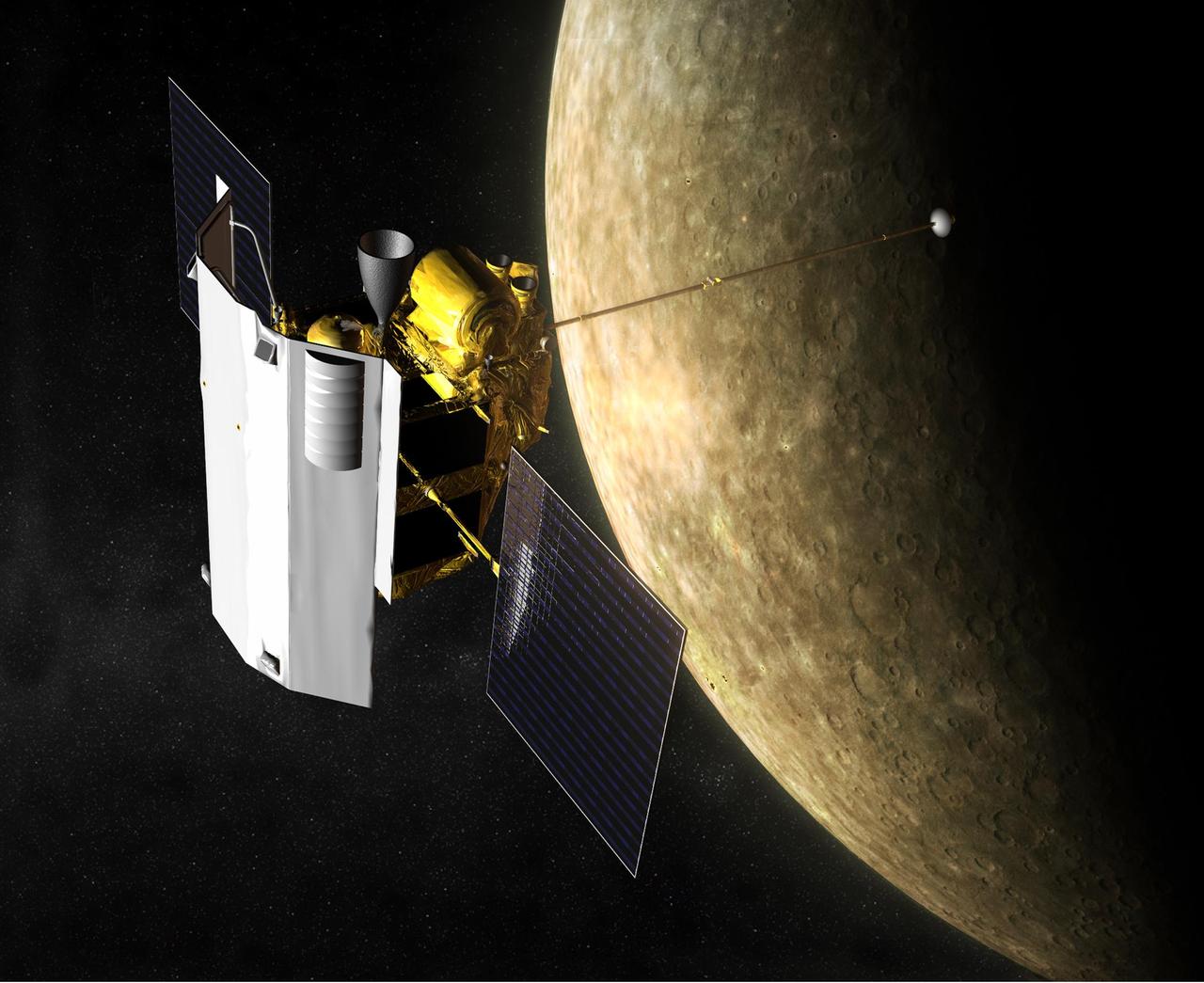
Eight years after launch, BepiColombo is about to let go of the vehicle that got it there. On September 3, 2026, at 14:00 CEST, the spacecraft's Mercury Transfer Module (MTM) — the propulsion and power module that has hauled the mission across the inner solar system since October 2018 — will separate from the two science orbiters it carried. ESA's Mission Control Center in Darmstadt, Germany, expects to confirm the split via signal acquisition at 15:53 CEST, and the agency is streaming the event live starting at 13:45 CEST.
It's a quiet-sounding milestone with a loud label attached. ESA describes what follows as "the first step" in what it calls "one of the most demanding operational sequences ever carried out by ESA." The transfer module's job is done; from here, the joint ESA/JAXA mission has to fly the rest of the way to Mercury orbit on its own.
What Happens Next
BepiColombo isn't one spacecraft — it's two, stacked together for the cruise phase. ESA's Mercury Planetary Orbiter (MPO) and JAXA's Mercury Magnetospheric Orbiter, nicknamed Mio, have been riding inside the transfer module's structure since launch. Wednesday's separation strips away that outer module, leaving the two orbiters to make the rest of the journey together.
The next major event comes in November 2026, when MPO and Mio are scheduled to enter orbit around Mercury as a combined unit — arrival is pinned to November 21, according to a JAXA-sourced arrival date reported by The Register. That's followed by a second separation on December 10, 2026, this time splitting the two science orbiters from each other so each can settle into its own orbit around the planet. Only after that does the mission's actual science work start: instrument commissioning and operations are set to begin in April 2027, roughly nine years after launch.
That's a lot of choreography for a planet as small as Mercury, and there's a reason for it. Mercury sits deep in the Sun's gravity well, and a spacecraft arriving from Earth carries far too much velocity to simply slow down and drop into orbit — it has to bleed off energy gradually. BepiColombo does this with a long series of gravity-assist flybys of Earth, Venus, and Mercury itself, plus continuous low-thrust propulsion from its solar-electric engines, rather than the single dramatic braking burn used by missions headed to easier destinations.
A Mission That's Already Overcome One Crisis
BepiColombo wasn't originally supposed to arrive this late. A thruster malfunction forced mission controllers to recalculate the spacecraft's trajectory, adding roughly 11 months to the timeline and pushing the Mercury arrival from an earlier target into November 2026, according to reporting from The Register and independently corroborated by Space.com. Both outlets agree on the cause — a propulsion problem — and the resulting delay, even as neither publication detailed the specific technical fault or how engineers worked around it.
The mission has effectively already proven it can absorb a serious setback and still reach its destination. That matters heading into a phase where ESA is signaling, unusually bluntly, that the difficulty is about to spike.
Built to Survive the Sun's Neighborhood
Once it arrives, MPO faces an environment that punishes spacecraft in ways most planetary missions never encounter. Mercury orbits close enough to the Sun that solar heating is extreme, and the planet's own dayside surface — baked to hundreds of degrees — radiates heat back at any spacecraft orbiting overhead. To cope, MPO carries radiators plus roughly 94 kilograms of insulation, according to The Register's reporting, dedicated to keeping the orbiter's electronics and instruments within operating temperature.
Mio, JAXA's magnetospheric orbiter, is scheduled to separate on December 10, 2026 — the second of the mission's two big separation events — freeing each orbiter to pursue its own science orbit and observation plan around the planet.
Why It Matters
Mercury is the least-visited of the solar system's rocky planets, and BepiColombo is only the third mission in spaceflight history to reach it — following NASA's Mariner 10, launched in 1973, which flew past the planet three times in 1974 and 1975, and MESSENGER, launched in 2004, which became the first spacecraft to enter orbit around Mercury in 2011. Every planetary mission accumulates fans and headlines, but Mercury exploration in particular remains rare because the destination is so hard to reach: a spacecraft launched toward the Sun picks up enormous velocity from the Sun's gravity, and shedding that speed without overshooting or crashing takes years of carefully sequenced flybys.
BepiColombo's dual-orbiter design — a European planetary science platform and a Japanese magnetospheric probe, launched together and separating only after arrival — is itself a rare piece of international engineering, and this week's transfer-module separation is the point where the mission stops coasting and starts threading the needle. ESA's own characterization of the coming weeks as among its most demanding operations ever is worth taking at face value: a mistake in the November orbit-insertion sequence, arriving so soon after the mission has already survived a thruster-driven, nearly year-long delay, would jeopardize one of the only chances scientists get each generation to study Mercury up close.