
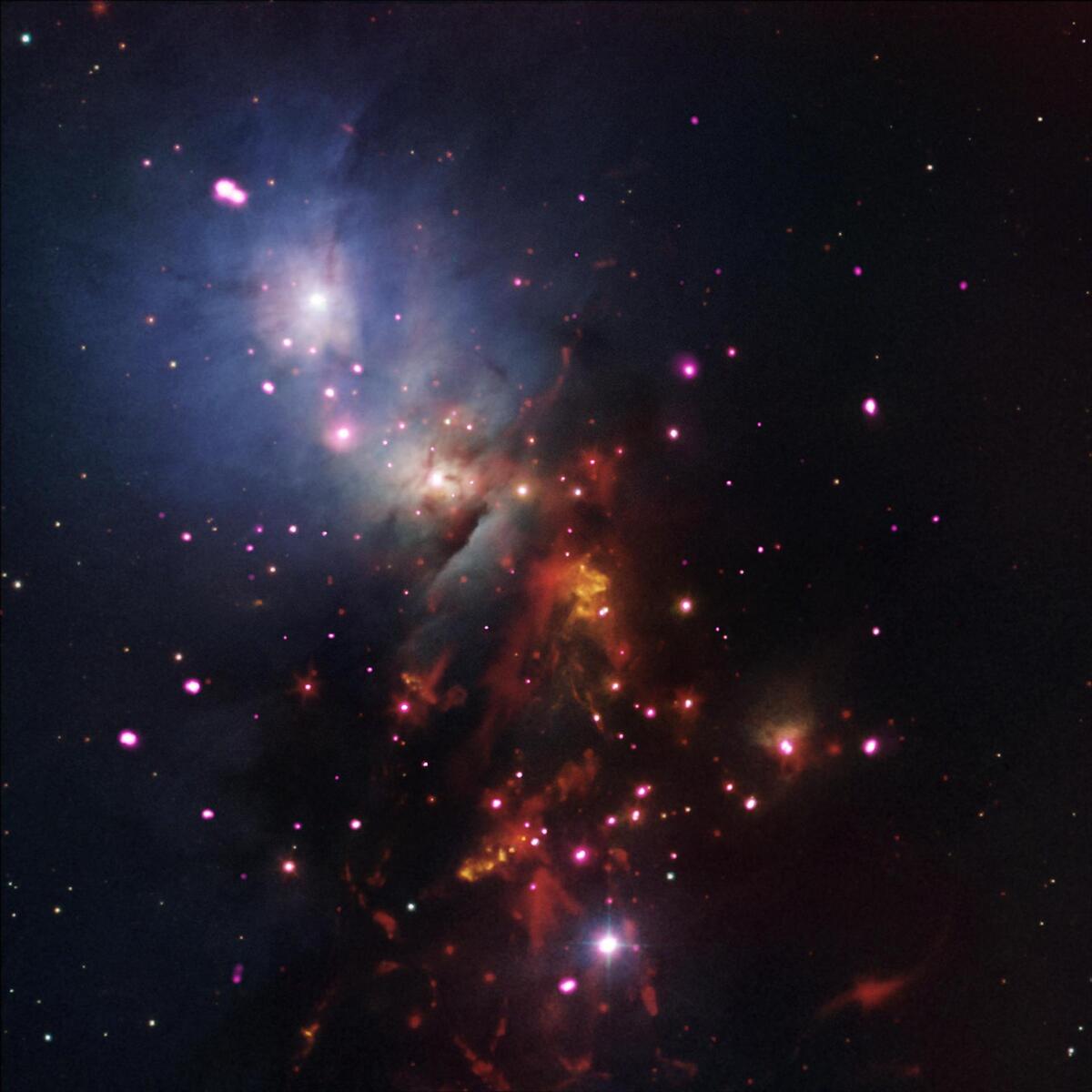
The universe has a habit of deceiving astronomers. What appears as a single bright event in one instrument may be three dim objects hiding in plain sight when observed with higher resolution. This lesson emerged sharply from a recent deep observation of NGC 6540, a globular cluster, when NASA's Chandra X-ray Observatory turned its gaze toward a puzzle that had puzzled the community for years: an X-ray flare that didn't fit the textbooks.
In 2018, the EXTraS (Exploring the X-ray Transient and Variable Sky) survey published analysis of an anomalous event in NGC 6540. An XMM-Newton observation from September 2005 had detected a brief, intense burst of X-rays lasting roughly 300 seconds—a timescale unusual for standard X-ray phenomena in globular clusters. The flare was bright enough to notice but cryptic enough to resist easy classification. Was it an active stellar binary? An optical illusion created by gravitational lensing? The question lingered.
Globular clusters present a unique challenge for X-ray astronomy. These ancient collections of hundreds of thousands of stars, orbiting in gravitational lockstep, are cosmic pressure cookers where stellar encounters happen frequently. X-ray sources abound—accreting neutron stars, white dwarfs siphoning material from companions, even occasional stellar collisions. In such crowded environments, distinguishing individual sources requires seeing power that most telescopes cannot muster. XMM-Newton's resolution was insufficient to untangle the mystery.
Chandra, with its sub-arcsecond pointing accuracy and finer spatial resolution, was built for exactly this task. A deep observation spanning approximately 65 kiloseconds—roughly 18 hours—revealed what had appeared singular to XMM-Newton: three distinct X-ray sources clustered near the position of the original flare. The separations between them ranged from 1.5 to 2.5 arcseconds, close enough that cruder instruments would smear them into a single detection, yet distinct enough for Chandra's instrumentation to resolve cleanly.
The discovery raises an immediate question: which of these three sources produced the dramatic 300-second flare observed years earlier? Or did the flux from one of them account for the apparent outburst? Research into NGC 6540 suggests the most likely explanation is that this source is a chromospherically active binary in the cluster—a binary system where one component exhibits high levels of magnetic activity and produces occasional, intense X-ray flares. The unusual luminosity and brief duration of the event fit this interpretation, though the precise mechanisms remain under study.
The resolution of NGC 6540's mystery illustrates a broader principle in modern X-ray astronomy. Globular clusters contain some of the densest concentrations of X-ray sources in the galaxy—many such sources remain poorly understood, partly because their separation is comparable to or smaller than the resolution of available instruments. As Chandra accumulates deep exposures of well-chosen targets, a more nuanced picture emerges: what appears as chaos at low resolution resolves into individual stories of stellar violence, accretion, and binary evolution.
The technical achievement here merits emphasis. Maintaining Chandra's pointing stability for 65 kiloseconds while achieving sub-arcsecond precision localization is no trivial feat. Each deep observation consumes valuable observing time that could be directed elsewhere. The decision to observe NGC 6540 proved scientifically worthwhile: the observation resolved a genuine anomaly and revealed the structure of this crowded stellar region.
Why It Matters
The ability to resolve confused X-ray sources directly addresses a central question in astrophysics: what is the true census of compact objects and binary systems in globular clusters? These old stellar systems encode the gravitational history of the galaxy—how clusters formed, merged, and evolved over cosmic time. The binaries within them, born from stellar collisions and tidal interactions, serve as laboratories for understanding accretion, mass transfer, and the endpoints of stellar evolution.
Moreover, the NGC 6540 observation underscores the enduring scientific value of high-resolution X-ray telescopes. As missions like Chandra continue observations, the resolution of subtle mysteries in crowded stellar environments—neither flashy nor immediately applicable, yet scientifically rich—justifies continued investment in precision X-ray astronomy. Each source resolved is a story told more fully, and in globular clusters, such stories are abundant and waiting.