
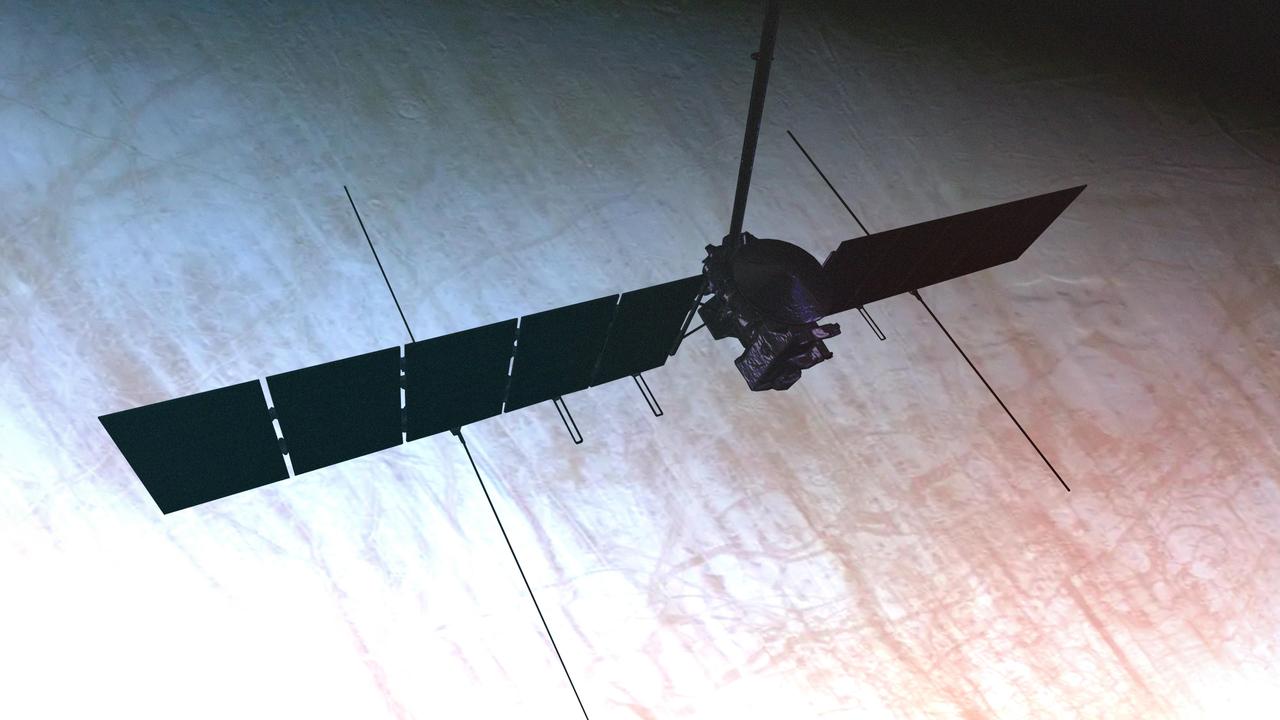
Somewhere between Earth and Jupiter, the largest spacecraft NASA has ever built for a planetary mission is coasting toward one of the most compelling destinations in the solar system. Europa Clipper, which launched on October 14, 2024, is bound for Jupiter's icy moon Europa, where a global ocean of liquid water is thought to lie beneath the ice. Its job, when it arrives in 2030, is to answer a single profound question: could that hidden ocean support life?
Why orbit Jupiter, not Europa
The mission's design is shaped entirely by radiation. Europa sits deep within Jupiter's enormous magnetic field, bathed in charged particles intense enough to quickly cripple a spacecraft's electronics. Rather than orbit the moon directly and absorb that punishment continuously, Europa Clipper will orbit Jupiter and execute nearly 50 close flybys of Europa, dipping in to gather data and then retreating to the relative safety of more distant space between passes. Its most sensitive electronics ride inside a radiation vault with titanium and aluminium walls — a shielding strategy first proven on NASA's Juno mission. It is a clever way to study a hostile environment without being destroyed by it.
A spacecraft built big for a dim Sun
Europa Clipper is genuinely enormous. It stands roughly 16 feet tall and stretches more than 100 feet across with its solar arrays deployed, with a dry mass of about 7,145 pounds. Those vast arrays are not a luxury but a necessity: at Jupiter, more than five times farther from the Sun than Earth, sunlight is faint, and only a large collecting area can power the spacecraft and its instruments. It carries nine science instruments — cameras, spectrometers, a magnetometer, gravity-science tools, thermal sensors, and, crucially, an ice-penetrating radar designed to probe the structure of the shell and search for water within and beneath it.
What it is really looking for
Europa Clipper will not search for life directly. Instead its three science goals are to characterise the ice shell and what lies below, to investigate the moon's composition, and to study its geology — together building a verdict on habitability rather than a detection of biology. Does Europa have the ingredients life requires: liquid water, the right chemistry, and a source of energy? Answering that would transform the search for life beyond Earth, shifting the question from whether habitable environments exist elsewhere in our solar system to whether one of them, just down the gravitational well of Jupiter, is actually inhabited. For now, the spacecraft cruises on, years from its target, carrying instruments built to read a buried sea it will never touch.
Why scientists are so confident the ocean is there
The case for Europa's hidden ocean was built long before Clipper launched. NASA's Galileo spacecraft, orbiting Jupiter in the 1990s and early 2000s, detected magnetic-field disturbances best explained by a global, salty, electrically conductive layer beneath the ice — a subsurface sea. The Hubble Space Telescope later reported tentative signs of water-vapour plumes erupting from the surface, hinting that the ocean might vent material into space where a passing spacecraft could sample it. Europa Clipper's instruments are designed to test and extend those clues, from the ice-penetrating radar that will probe the shell to the spectrometers that will read the chemistry of the surface and any plumes.
Part of a wider hunt for ocean worlds
Europa is the marquee target, but it is no longer alone. The outer solar system has turned out to be surprisingly wet: Saturn's moon Enceladus famously jets plumes of ocean water into space, and several other icy moons are suspected of harbouring subsurface seas. Europa Clipper arrives at Jupiter around the same era as the European Space Agency's Juice mission, which is bound for the same system to study Ganymede, Callisto, and Europa from a different angle. Together they represent a coordinated push to determine whether the icy moons of the outer planets — long dismissed as frozen and inert — are in fact among the most promising places in the solar system to look for life.