
In 1936, physicists Werner Heisenberg and Hans Heinrich Euler worked out a strange consequence of quantum electrodynamics: in a strong enough magnetic field, empty space should stop behaving like nothing. Virtual particles flickering in and out of the vacuum would subtly bend light passing through it, splitting it the way a crystal splits light in a birefringent lens. The effect, called vacuum birefringence, requires magnetic fields so extreme that no laboratory on Earth has ever come close to producing one. For nine decades it has remained a prediction on paper.
That may have changed. According to a NASA announcement published August 5, 2026, a team led by Rachael Stewart, a PhD candidate at George Washington University, and Hoa Dinh Thi, a postdoctoral researcher at Rice University, has detected X-ray polarization behavior from a magnetar that "cannot be consistently explained" without invoking vacuum birefringence. The result, published in Nature, draws on data from NASA's Imaging X-ray Polarimetry Explorer (IXPE), the NICER telescope, and CSIRO's Murriyang radio telescope in Australia.
The Target: A Magnetar Spinning Once Every 2.1 Seconds
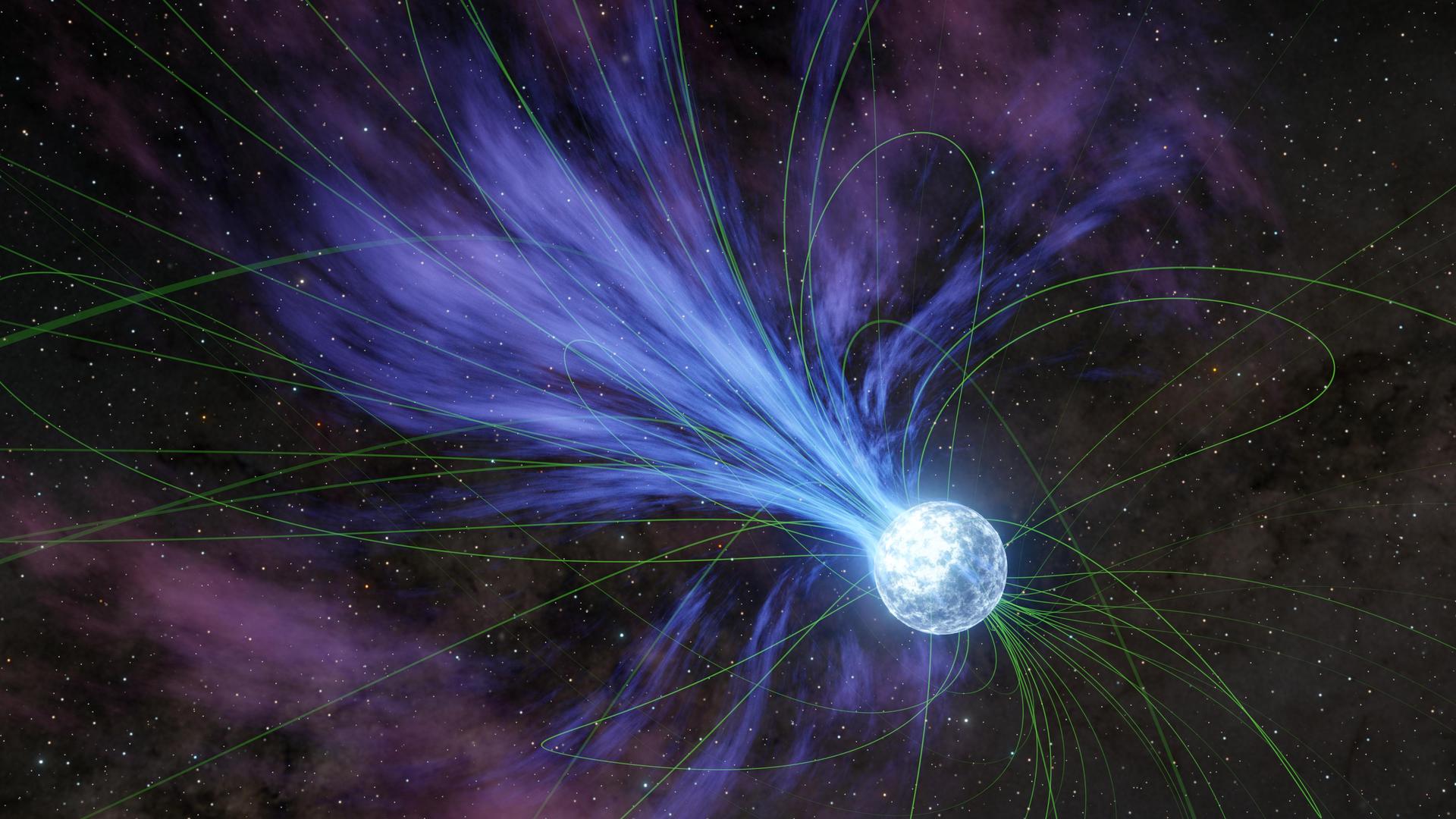
The object in question, 1E 1547.0-5408, is a magnetar — a type of neutron star wrapped in a magnetic field roughly a trillion times stronger than Earth's. It rotates once every 2.1 seconds, and researchers trained IXPE and NICER on it during observations in March and April 2025, cross-referencing the X-ray data with radio timing from Murriyang.
What they found, according to the team's preprint posted to arXiv (first submitted September 23, 2025, and revised February 27, 2026), was extreme: X-ray polarization of 65% at 2 keV, climbing to nearly 80% at certain points in the magnetar's rotation, then declining as photon energy rose from 2 to 4 keV. For comparison, ordinary polarized light sources rarely approach numbers like that — an 80% polarization fraction is about as "clean" a signal as X-ray astronomers ever see.
Why Polarization Is the Key
Vacuum birefringence doesn't announce itself directly — nobody can see empty space bending light with the naked eye. Instead, physicists look for its fingerprint in how polarized light behaves as it travels through an intense magnetic field. If QED is right, the magnetar's field should act like a lens that locks X-ray photons into a specific polarization state as they leave the star's magnetosphere, regardless of how they started out. The steep, energy-dependent shift the team measured — polarization peaking near 80% and then fading — matches what theory predicts if the vacuum itself is doing the work, rather than some property of the star's surface or emission mechanism alone.
The preprint lists 16 authors in total, including George Younes, Matthew G. Baring, and Alice K. Harding alongside Stewart. The peer-reviewed version, carrying the same title, "Evidence of magnetospheric vacuum birefringence in the polarized X-rays of a radio magnetar," is now published in Nature under DOI s41586-026-10859-z, matching both the arXiv preprint and NASA's public description of the findings.
Why It Matters
Vacuum birefringence sits at the intersection of two things physicists usually study separately: quantum field theory, which governs the smallest scales, and gravity/magnetism at astrophysical scales. Confirming it means quantum electrodynamics — already one of the most precisely tested theories in physics — holds up even in magnetic fields that are utterly impossible to replicate on Earth, by many orders of magnitude. It's a rare chance to test fundamental physics using a natural laboratory instead of a particle accelerator.
It also validates magnetars as functioning tools for probing physics: 1E 1547.0-5408 isn't just an object worth cataloguing, it's an instrument for measuring how nature behaves at extremes no engineer could build. And practically, it demonstrates the value of combining IXPE's X-ray polarimetry with NICER's timing and Murriyang's radio data — a multi-instrument approach the same team is likely to reuse on other magnetars, potentially turning a single striking result into a broader research program.
A Result Nearly a Century in the Making
Stewart, quoted in NASA's release, framed the discovery as a product of connecting fields that don't always talk to each other — combining X-ray polarimetry, radio timing, and quantum field theory to chase down a signature that's been sitting in the equations since before World War II. Heisenberg and Euler never had a magnetar to point a telescope at. Eighty years after IXPE-style polarimetry became conceivable, and 90 years after the original prediction, astronomers finally had both the instrument and the object needed to look for it.
The result isn't the final word — as with any single-object detection, independent confirmation on other magnetars would strengthen the case considerably. But for a prediction that has waited nine decades for a test, an 80% polarization signal that resists any explanation except vacuum birefringence is about as strong a first answer as physicists could have hoped for.
Sources
- NASA: "NASA's IXPE May Have Proven 90-Year-Old Theory"
- Stewart et al., "Evidence of magnetospheric vacuum birefringence in the polarized X-rays of a radio magnetar" (arXiv preprint)
- Nature: "Evidence of magnetospheric vacuum birefringence in the polarized X-rays of a radio magnetar" (DOI s41586-026-10859-z)