
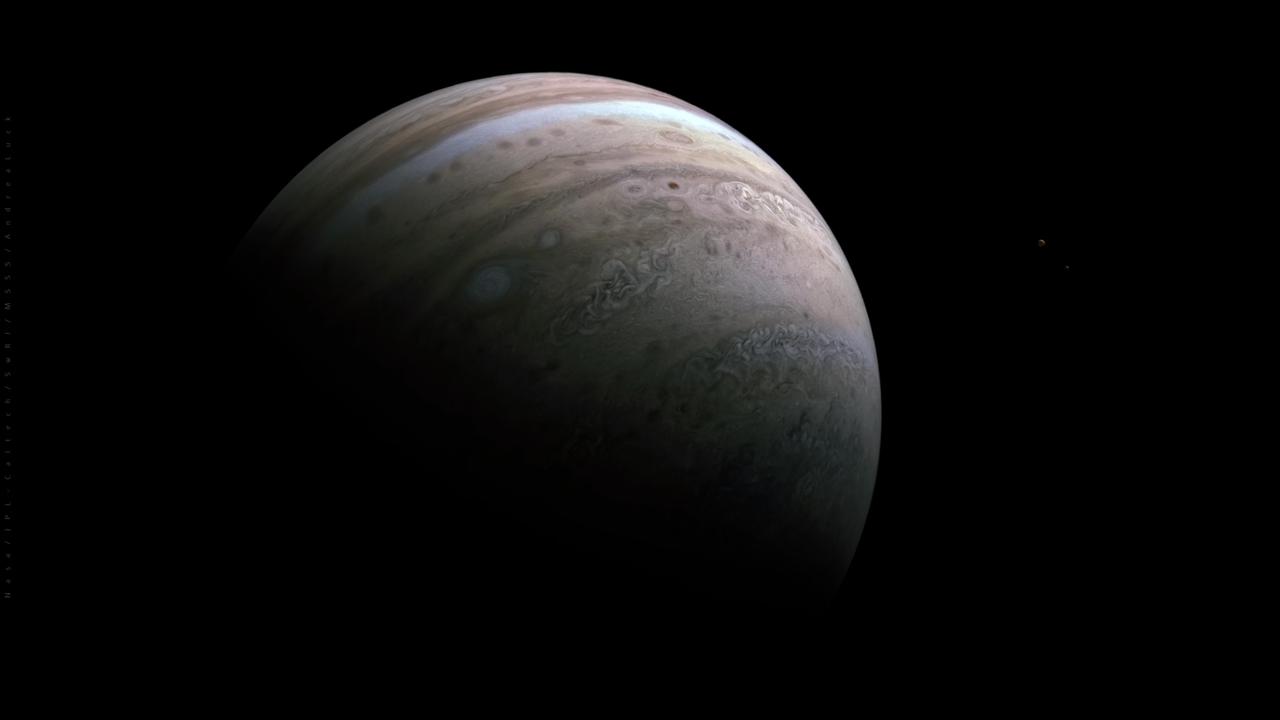
When NASA launched Juno in August 2011, the plan was a focused, finite campaign: arrive at Jupiter in 2016, spend a year peering beneath its clouds, and then dive to a fiery end in the planet's atmosphere. Nearly fifteen years after launch, the spacecraft is still flying — and still returning results that force textbooks to be rewritten. In May 2026 it captured the small inner moon Thebe during a close pass, one more encounter in a mission that long ago outgrew its original mandate.
A second life among the moons
After completing its primary mission, Juno's trajectory was reshaped by gravitational encounters with the Galilean moons, dropping it into roughly 33-day orbits and steering it past Jupiter's major satellites one by one: a close flyby of Ganymede in 2021, Europa in 2022, and Io in late 2023 and early 2024 — the latter the closest approach to that volcanic moon in two decades, revealing fresh lava fields in regions not imaged since the Galileo and New Horizons flybys. The Thebe pass extends that tour to one of Jupiter's smaller, less-studied inner moons. On its closest approaches to the planet itself, Juno skims roughly 3,500 kilometres above the cloud tops, threading between Jupiter's punishing radiation belts on a pole-to-pole path.
What Juno has overturned
The discoveries have been fundamental. Juno's microwave radiometer showed that Jupiter's banded atmosphere is not a thin veneer but extends some 3,000 kilometres down. Its gravity measurements revealed a core that is far larger than expected and, strangely, partially dissolved — with no sharp boundary between the core and the metallic hydrogen swirling around it, upending the textbook picture of a neat rocky centre. The magnetic field proved far more intense and irregular than predicted, in places more than 30 times stronger than Earth's. At the poles, Juno found clusters of giant cyclones — eight surrounding a central vortex at the north pole, each more than 2,500 miles across — and lightning that drives "mushballs," softball-sized hailstones of ammonia and water. It even resolved a long-standing puzzle from the 1995 Galileo probe's surprisingly dry descent, showing that water is far more abundant near Jupiter's equator than the single probe happened to sample.
The slow goodbye
Juno's extended mission was authorised to continue its investigation of the giant planet and its moons, with the spacecraft ultimately destined to be drawn into Jupiter's atmosphere and consumed — a controlled end that ensures it cannot one day contaminate a potentially habitable moon like Europa. Until then, every orbit is a bonus, and every flyby like Thebe's adds another data point to a portrait of Jupiter that Juno has, more than any mission before it, redrawn from the inside out.
Storms with roots, and a shrinking spot
Some of Juno's most vivid findings concern Jupiter's weather. The Great Red Spot, the planet's signature storm, turns out to have roots extending roughly 200 miles deep — and it is slowly shrinking, from about twice Earth's width in 1979 to around 1.3 times today. At the poles, the spacecraft's instruments revealed auroras of astonishing energy, with electrons accelerated to hundreds of thousands of electron volts, far beyond anything seen at Earth, and an invisible magnetic feature nicknamed the "Blue Spot" drifting slowly eastward. Together these observations have turned Jupiter from a flat picture of colourful bands into a deep, dynamic, three-dimensional world.
A blueprint for the missions that follow
Juno's legacy is also methodological. Its radiation vault — a titanium enclosure shielding the electronics from Jupiter's ferocious particle environment — proved a design that later missions, including the Europa Clipper now en route to the same system, have adopted. By mapping where the radiation is most intense and how the magnetosphere behaves, Juno effectively scouted the hazards for everything that comes after it. When future spacecraft thread Jupiter's belts to study its ocean moons, they will be navigating an environment Juno was the first to chart in detail.