
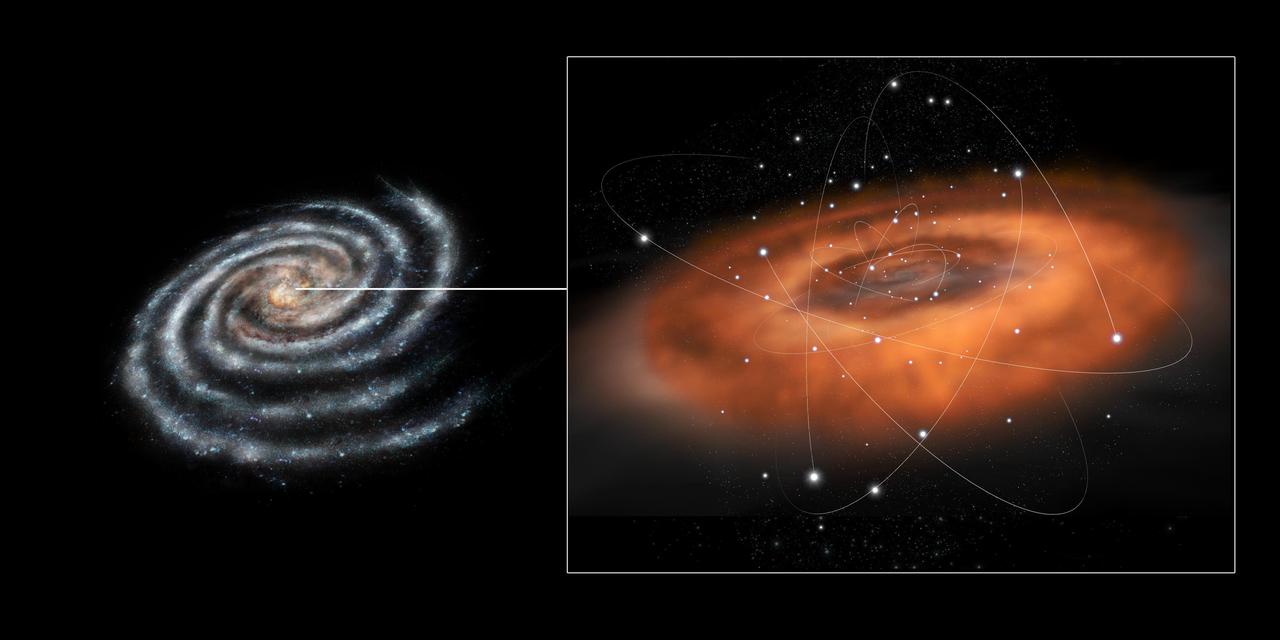
The supermassive black hole at the centre of the Milky Way, Sagittarius A*, has a reputation for being boring. Compared with the blazing quasars that anchor distant galaxies, it consumes very little and radiates faintly — a four-million-solar-mass giant sitting, for the most part, in the dark. That quietness is exactly what has made one question so stubborn: does even a dormant black hole push back on the galaxy around it? After roughly fifty years of looking, astronomers can finally answer yes.
A cavity carved in cold gas
Using five years of deep observations from the Atacama Large Millimeter/Submillimeter Array (ALMA) in Chile, a team has detected the signature of powerful winds blowing outward from Sagittarius A*. The evidence takes the form of a cone-shaped cavity, swept clean of cold molecular gas, carved by hot energetic material streaming away from the black hole. The new ALMA maps are described as roughly 100 times deeper and 80 times sharper than previous efforts — the leap in sensitivity that finally made the faint outflow visible against the cluttered, dust-choked backdrop of the galactic centre. Data from NASA's Chandra X-ray Observatory helped confirm the picture.
Why it took so long
"There is the thing that everybody's been looking for for 50 years," said Mark Gorski of Northwestern University, who co-led the study with Elena Murchikova. The half-century delay was not for lack of trying. Sagittarius A* is in a quiet phase, its outflows correspondingly subtle, and the galactic plane between us and the centre is a thicket of gas, dust, and ionised structures that obscure exactly the signal astronomers wanted to isolate. Seeing it required both an instrument sensitive enough to detect the faint cavity and patient enough to integrate years of data.
What a quiet black hole still does
The finding matters because of what it says about feedback — the process by which a black hole influences its host galaxy. The dramatic version is easy to study: active galactic nuclei launch jets and winds that can heat and expel a galaxy's gas, throttling star formation. The question has been whether quiet black holes like ours do anything comparable. The detection of winds from Sagittarius A* suggests that even in its dormant state, the black hole is actively transforming its immediate environment, sculpting the distribution of gas from which future stars might form. It is a reminder that "quiet" is relative; the galaxy's central engine is idling, not off.
For researchers building models of how galaxies and their central black holes co-evolve, having a nearby, low-luminosity example of feedback in action is valuable precisely because it is the common case. Most black holes in the universe, most of the time, are quiet ones. Catching ours in the act of exhaling — after generations of astronomers suspected it must — turns a theoretical expectation into an observation, and gives the textbooks a local benchmark for the gentle, persistent way a sleeping giant shapes its surroundings.
The difference between a quasar and a neighbour
To appreciate why the result is subtle, it helps to compare Sagittarius A* with its loud cousins. In distant galaxies, supermassive black holes can accrete matter so furiously that they outshine all the stars around them, blasting out jets and winds that reshape entire galaxies — the engines we call quasars and active galactic nuclei. Our black hole does nothing of the sort. It is starved, accreting a trickle of material and radiating feebly, which is why the winds now detected are correspondingly gentle and were so hard to find. The cone-shaped cavity in the cold gas is the fossil record of that faint exhalation, integrated over time.
A benchmark on our doorstep
Its proximity is the payoff. At roughly 27,000 light-years away, Sagittarius A* is the only supermassive black hole close enough to study at this level of detail, and the only one where astronomers can hope to map the structure of such a weak outflow directly. Every distant quiescent black hole — and most black holes are quiescent most of the time — must be understood by analogy. Having a nearby, well-resolved example of low-level feedback in action gives modellers a calibration point they have never had, anchoring simulations of how the universe's most common black holes quietly regulate the galaxies they inhabit.