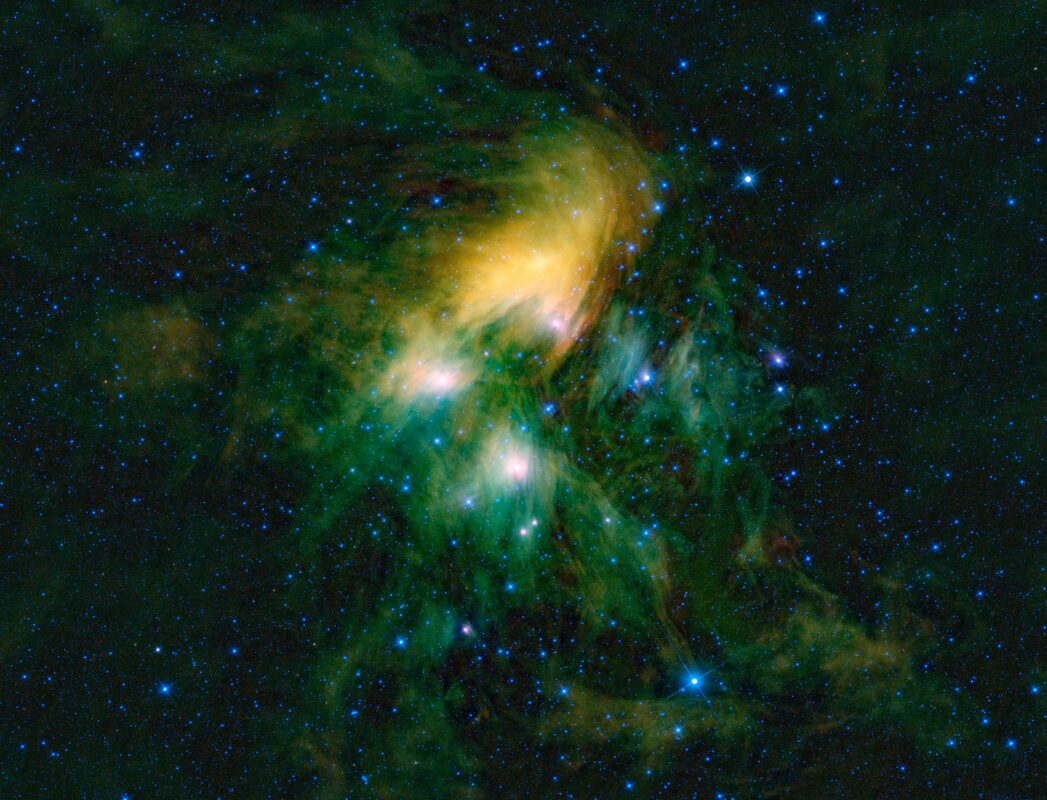
The Moon has a busy week ahead. Starting the night of September 2-3, 2026, the waning gibbous Moon drifts close to the Pleiades star cluster — the tight, glittering knot of stars also known as M45 or the Seven Sisters — before pulling away toward a rendezvous with Mars on September 6 and, two days after that, an actual disappearing act: the Moon will pass directly in front of Jupiter, blocking the planet from view for observers along a swath of the Northern Hemisphere.
None of this requires equipment. That's the appeal of a lunar conjunction season — the events described here are naked-eye, though binoculars sharpen the Pleiades encounter considerably and a small telescope turns the Jupiter occultation into a genuine spectacle.
A Moon-Pleiades close approach to open the month
On the nights of September 2 and 3, the Moon — still waning gibbous, several days past full and well past its brightest — passes near the Pleiades cluster, according to skywatching guide EarthSky, with independent tracker In-The-Sky.org confirming the close approach specifically on September 3. The Moon is bright at this phase, which will wash out some of the cluster's fainter stars to the unaided eye, but the pairing is still an easy, no-instrument target: look for the compact smudge of stars sitting near the Moon in the pre-dawn sky.
The Moon then continues its circuit through the calendar's early markers. EarthSky logs the third-quarter Moon at 7:51 UTC on September 4; In-The-Sky.org puts last quarter at 12:51 a.m. PDT the same date. A few days later, on September 6, the Moon passes near Mars, per In-The-Sky.org — a fainter pairing than the Jupiter event to come, but part of the same week-long procession of the Moon across the sky's bright objects.
The main event: an occultation of Jupiter
The week's headline event lands on September 8. The Moon — by then a slimming crescent — passes near Jupiter, and for observers in the right location, it does more than pass near: it occults the planet, moving directly in front of it and blocking it from view. EarthSky places the occultation at approximately 18:00 UTC on September 8; In-The-Sky.org corroborates the event and specifies its visibility footprint: Canada, the contiguous United States, Greenland and Russia, among other countries and territories.
An occultation works exactly the way it sounds — the Moon, orbiting far closer to Earth than any planet, briefly slides across the same line of sight and covers the more distant object. Because the Moon has no atmosphere to blur the edge, the effect is abrupt: Jupiter simply vanishes at the Moon's dark limb and reappears, just as suddenly, on the other side sometime later. Exact local timing and whether the event is visible at all depends on where you're standing — occultation footprints are narrow and time-sensitive by nature, so skywatchers within the stated visibility zone should check a local timing source for their specific coordinates rather than relying on the UTC midpoint alone. EarthSky also flags a Moon-Jupiter pairing continuing into September 8-9, framing the occultation as the peak of a broader close approach rather than an isolated instant.
What comes after: new Moon, Venus, and the equinox
The Moon reaches new phase shortly after the Jupiter event — EarthSky dates it to September 11, while In-The-Sky.org places new Moon on September 10, a discrepancy likely reflecting different time-zone reference points for a phase that occurs near a UTC date boundary. Either way, the days around new Moon offer the darkest skies of the month, useful for anyone chasing fainter deep-sky targets away from lunar glare.
The Moon isn't finished for the month, either. In-The-Sky.org notes a Moon-Venus pairing on September 14, and both trackers converge on the month's other headline events: Venus reaches greatest brilliancy on September 18, per EarthSky, meaning the planet hits its peak apparent magnitude as seen from Earth — the point in its orbital cycle when its combination of distance, phase, and reflected sunlight makes it shine most intensely. In-The-Sky.org separately notes Uranus stations retrograde on September 10, a more subtle event given the planet's dimness to the naked eye.
The month closes with two more milestones. The September equinox falls on September 22, according to In-The-Sky.org — the moment the Sun crosses the celestial equator, marking the start of astronomical autumn in the Northern Hemisphere. And on September 26, EarthSky notes the full Harvest Moon rises near Saturn. NASA's own September 2026 skywatching guide frames the month around exactly this bookend: using the Moon early on to find Antares and the "Teapot" asterism in Sagittarius, tracking Venus's brilliance, marking the equinox, and closing with the Harvest Moon near both Saturn and Neptune.
Why It Matters
Occultations and close conjunctions like these are not rare astronomical events in the sense that eclipses are — the Moon passes near bright planets and prominent star clusters on a predictable monthly cadence as it orbits Earth. What makes September's run notable is stacking and visibility: a Pleiades approach, a Jupiter occultation with a wide and populated visibility footprint across North America and beyond, and a Venus brilliancy peak all land within roughly two and a half weeks of each other, all visible without a telescope, binoculars, or any special equipment beyond clear skies and a bit of patience. Occultations in particular are useful beyond the view itself: because the Moon's edge is airless and sharp, timing exactly when a planet or star disappears and reappears gives astronomers precise geometric data, a technique with a long history in refining our knowledge of the Moon's exact position and shape. For casual skywatchers, though, the value is simpler — a genuinely striking, easy-to-find sight that doesn't demand a trip to a dark-sky site, just a clear view of the Moon on the right night.