
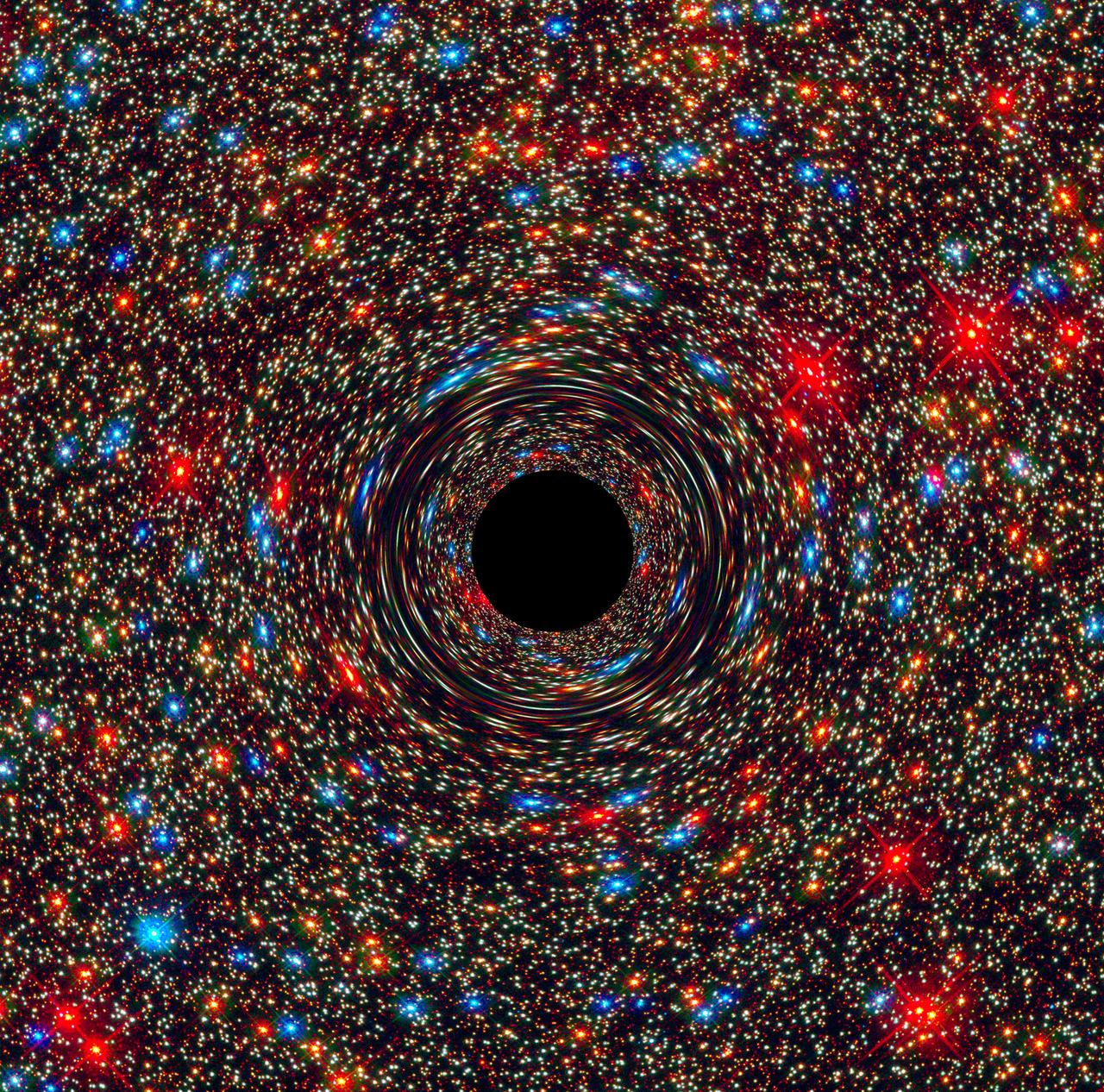
Astronomers have identified what appears to be the most massive pair of supermassive black holes ever detected — two ultramassive objects with a combined mass of roughly 60 billion times that of the Sun, double the previous record holder. The pair sits at the centre of the galaxy Abell 402-BCG, about 4.4 billion light-years away, and the two are locked in a slow spiral that is destined to end in one of the largest black hole mergers the universe can produce.
Found by an absence
The discovery is unusual because the black holes announced themselves not by what they emit but by what they have removed. The first hint came in 2018, when astronomers noticed an oddly dark, star-free region spanning some 3,200 light-years across the galaxy's core. The obvious explanation was a screen of dust blocking the starlight. New observations with the James Webb Space Telescope and the European Southern Observatory's Very Large Telescope ruled that out: the gap is genuinely empty of stars. The most plausible cause is a pair of ultramassive black holes that, as they spiral together, gravitationally flung the surrounding stars clear — scouring out the void that betrayed their presence.
A rare snapshot of a merger in progress
The work, led by a team including MIT astronomer Michael McDonald and published in the Astrophysical Journal Letters on April 23, 2026, estimates that the two black holes have coexisted as a bound pair for only tens of millions of years — a blink in cosmic terms. That makes the system a rare snapshot of a stage in galactic evolution that is usually too brief, or too obscured, to catch. Galactic collisions are thought to drive central black holes together routinely, but observing a specific pair mid-merger, with masses this extreme, is exceptional.
What happens when they meet
The pair is destined to merge, and when it does, the result will likely be one of the largest black holes known in the universe. The event would also be a titanic source of gravitational waves — though at a frequency far below what ground-based detectors like LIGO can sense, in the regime that future space-based observatories and pulsar-timing campaigns are being built to probe. For now, the system is a laboratory for a process central to how the biggest galaxies and the biggest black holes assemble: not by gentle accretion alone, but by the violent mergers of galaxies and the slow, inexorable coalescence of the giants at their hearts. Watching one such giant pair on its way to union, frozen in a single image, is the closest astronomers have come to seeing the making of a true cosmic heavyweight.
Why "ultramassive" is its own category
Most supermassive black holes weigh millions to a few billion solar masses; our own galaxy's harbours about four million. At roughly 60 billion solar masses combined, the Abell 402-BCG pair sits in the rarefied "ultramassive" regime, near the theoretical upper limit of how large a black hole can grow. Such giants are found almost exclusively in the brightest galaxies at the centres of massive galaxy clusters — exactly the kind of environment, built up by repeated galactic mergers, where the raw material to feed a black hole to that size accumulates over billions of years.
Heard, eventually, not just seen
When the two finally coalesce, the merger will radiate gravitational waves of staggering power, but at frequencies far too low for ground-based detectors like LIGO, which are tuned to the mergers of stellar-mass objects. Catching the rumble of supermassive black hole binaries is instead the goal of pulsar timing arrays — which monitor the galaxy's millisecond pulsars for the collective nanohertz background such pairs produce — and of future space-based observatories. A confirmed, imaged ultramassive pair like this one helps calibrate expectations for those efforts, linking what astronomers can see in starlight to what they hope, one day, to hear in the fabric of spacetime.