
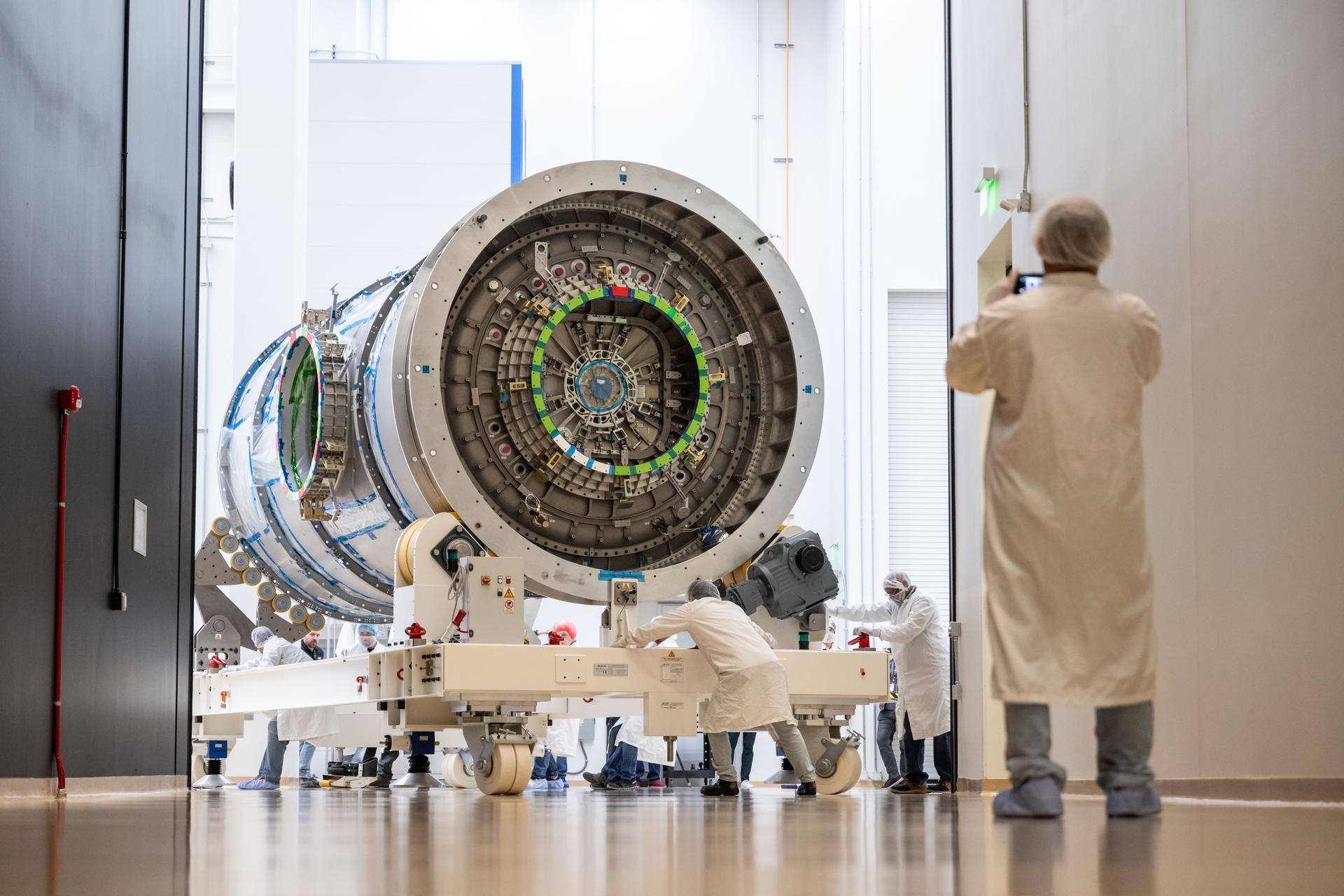
The hardware built for humanity's first lunar space station is getting a second job. NASA and Northrop Grumman announced this week that technology developed for Gateway's HALO (Habitation and Logistics Outpost) module — its power system, data backbone, thermal architecture, and communications gear — will be repurposed for a new set of missions aimed squarely at the lunar surface: three Lunar Infrastructure Demo flights designed to prove out "Moon Base" hardware at the Moon's South Pole.
The announcement lands at an awkward moment for Gateway, whose price tag has climbed steadily since the program began, and just weeks after NASA's Office of Inspector General circulated a pointed interim memo on how the agency manages canceled or repurposed Artemis programs — including Gateway's cost growth and schedule slips. The timing raises an obvious question: is this a clever pivot to get more value out of hardware NASA already paid for, or a sign that the orbiting station itself is in real trouble? Based on the public record so far, it looks like both.
What Northrop Grumman Announced
In an August 4 release, Northrop Grumman detailed the three-mission Lunar Infrastructure Demo program — LID-1, LID-2, and LID-3 — which will reuse HALO-derived systems to demonstrate that surface infrastructure can survive the lunar night and shadow periods at the South Pole, one of the hardest environmental problems facing any permanent Moon Base concept. The company is leaning hard on the fact that this technology is not conceptual. David Schiller, Northrop Grumman's Vice President of Civil Space and Sciences, put it bluntly: "Our ready-to-fly, reliable HALO technologies allow NASA to move faster."
That's a real selling point. HALO's power, thermal, and data systems have already been through years of design, qualification, and — as of NASA's own program updates — testing. The module itself arrived in the United States from Turin, Italy, where it was built by Thales Alenia Space, for final outfitting, and Gateway's power system was recently activated for the first time. Rather than starting a South Pole survival system from a blank sheet, NASA and Northrop Grumman are proposing to fly a derivative of hardware that's already largely built.
The Cost Story Behind the Pivot
The HALO contract's price history explains why NASA might want to squeeze more mission value out of it. According to reporting that traces the contract's evolution, HALO started as a $187 million award in 2019. By 2021 it had grown into a $1.3 billion firm-fixed-price contract. By September 2024, the figure was $1.8 billion. And in April 2026, NASA Administrator Jared Isaacman issued a stop-work order on a contract now valued at $1.9 billion — more than a tenfold increase from the original award.
That trajectory drew the attention of NASA's Office of Inspector General, which issued an interim draft memo on June 3, 2026, examining NASA's management of programs and projects after mission termination — specifically, canceled or repurposed Artemis Campaign Systems, a category that includes Gateway's HALO module. Deputy Assistant Inspector General for Audits Brian Mullins reported that the Gateway Program's own independent Standing Review Board had found a 0 percent likelihood of meeting its then-current launch readiness date, that Thales Alenia Space had discovered corrosion in the module's structure, and that delivery could slip to July 2031 — a six-year delay — with the station potentially not operational until at least 2032. Dr. Lori Glaze, NASA's Associate Administrator for Exploration Systems Development, responded in a letter dated June 18, 2026, stating that "the Agency looks forward to supporting the OIG's continued audit work on terminated missions and remains committed to transparency, responsible stewardship, and advancing America's leadership in lunar exploration." Read together, the sequence is telling: a stop-work order in April, a blunt IG assessment in June, and by August, an announcement that reframes HALO-derived technology around a new set of surface demonstration missions under a program NASA is calling Moon Base Phase One, which runs through 2029.
Q&A: What Does This Actually Mean for Gateway?
Does this mean Gateway is being canceled or descoped?
The public record here is genuinely mixed. NASA's own Gateway program page still describes the station as launching no earlier than 2027 into a near-rectilinear halo orbit, with HALO undergoing outfitting and the power system already in startup testing — no formal cancellation notice appears there. But the reporting around this announcement tells a different story: it frames the HALO repurposing explicitly as part of NASA's "decision to pivot away from the orbiting Gateway lunar station," and the OIG's own interim memo is titled around "canceled or repurposed Artemis Campaign Systems." Combined with the Standing Review Board's 0-percent-likelihood finding and the projected multi-year delay described above, the evidence suggests Gateway as originally conceived is in far more trouble than NASA's still-current webpage lets on — even though no source states outright that the program has been formally terminated.
Who's in charge, and who signs off on this?
Dr. Jon B. Olansen remains Gateway's Program Manager, and the initiative sits under NASA Administrator Jared Isaacman, who personally issued the April 2026 stop-work order. Dr. Lori Glaze, as Associate Administrator for Exploration Systems Development, is the official who responded directly to the Inspector General's findings on terminated and repurposed Artemis programs — placing her at the center of both the accountability conversation and, by extension, decisions about how Gateway-adjacent hardware gets used going forward.
Why the South Pole specifically?
The lunar South Pole is the target region for NASA's broader Artemis surface exploration plans. It's also a brutal environment for hardware: according to reporting on this announcement, temperatures there swing from roughly -334°F in shadow to 130°F in direct sunlight. That kind of extreme, combined with extended stretches of lunar night and shadow, is precisely the endurance problem HALO's power and thermal subsystems were engineered to solve in lunar orbit — Northrop Grumman's release frames the LID missions around keeping surface assets "powered, protected and connected through lunar night and shadow."
Is reusing Gateway tech for surface demos actually a good engineering call?
On paper, yes — flight-proven power, data, and communications architecture is exactly the kind of thing you want to inherit rather than reinvent, and NASA has a long history of adapting orbital hardware lineages for surface use. The open question is programmatic, not technical: whether spreading HALO-derived engineering across a station program already flagged for serious cost and schedule trouble and three new demo missions adds discipline or adds risk. That's likely to be a central theme of NASA's next public accounting of both efforts.
Why It Matters
Gateway has spent years positioned as the cornerstone of NASA's cislunar architecture — a staging point for Artemis surface missions and a permanent human foothold in lunar orbit. A contract that has grown more than tenfold since 2019, followed by a stop-work order, an Inspector General finding of a 0 percent likelihood of meeting its launch schedule, and a projected delay stretching to 2031 or beyond, is the kind of pattern that invites hard questions in Washington about whether the program is delivering value commensurate with its cost.
Repurposing HALO's power, thermal, data, and communications technology into the Lunar Infrastructure Demo missions gives NASA and Northrop Grumman a way to point to near-term, surface-relevant deliverables from hardware caught up in that scrutiny — real hardware demonstrating real capability at the South Pole, on a Moon Base Phase One timeline running through 2029, rather than a single high-profile station whose schedule keeps sliding. Whether that reframing satisfies the Inspector General's concerns about how NASA manages canceled or repurposed Artemis systems, or simply reflects that the original Gateway concept has quietly been stepped back from, isn't something NASA has addressed head-on — its own program page still describes a 2027 launch target even as outside reporting describes a pivot away from the station. For now, it's a signal that NASA is betting on HALO's engineering even as it reckons with HALO's price tag and its troubled schedule.