
There are at least one hundred billion stars in the Milky Way. The first exoplanet orbiting one of these stars was discovered in 1992. Since then thousands of exoplanets have been found orbiting thousands of stars. Almost every star system we have observed has one or more, half of which are rocky.
It is possible there are hundreds of millions of habitable planets in our galaxy. A consensus of scientists believes life out there is plausible and even likely, and eventually mankind will discover it. However, is it intelligent life, and can we find a way to communicate? This question sits at the heart of the Fermi Paradox: if intelligent life is common, why have we found no evidence of it? Before turning to the problems of communications, it helps to first ask how we might detect such life at all.
How would we even find it?
The galaxy is vast. There could be millions of advanced civilizations out there. How should we go about searching for them? Using the space-based HST and JWST, the recently launched Nancy Grace Roman Space Telescope or the future thirty-nine-meter ground-based ELT (Extremely Large Telescope), it may be possible to discover the signs of life on an exoplanet. First, the planet needs to be in its star's habitable zone, where surface temperature allows liquid water to exist. It also needs an atmosphere. Astronomers would be looking for elements and compounds in an alien atmosphere as signals. For example, methane is a good indicator of life, although not necessarily intelligent life. Nitrous oxide, oxygen, sulfur compounds and water vapor are thought to be necessary. Some more complex organic compounds found in the atmosphere would be desirable.
Not only is an atmosphere important — a magnetosphere, like Earth's protective shield, is necessary to preserve and protect a planet's atmosphere and lifeforms. HST has found evidence of one around the uninhabitable HAT-P-11b, one hundred and twenty-three light-years from Earth. There could be others, yet undiscovered, around habitable exoplanets. These factors only indicate there may be life on the planet — they do not define intelligent life. New technologies will be needed as screening tools to advance our search.
Listening for a signal
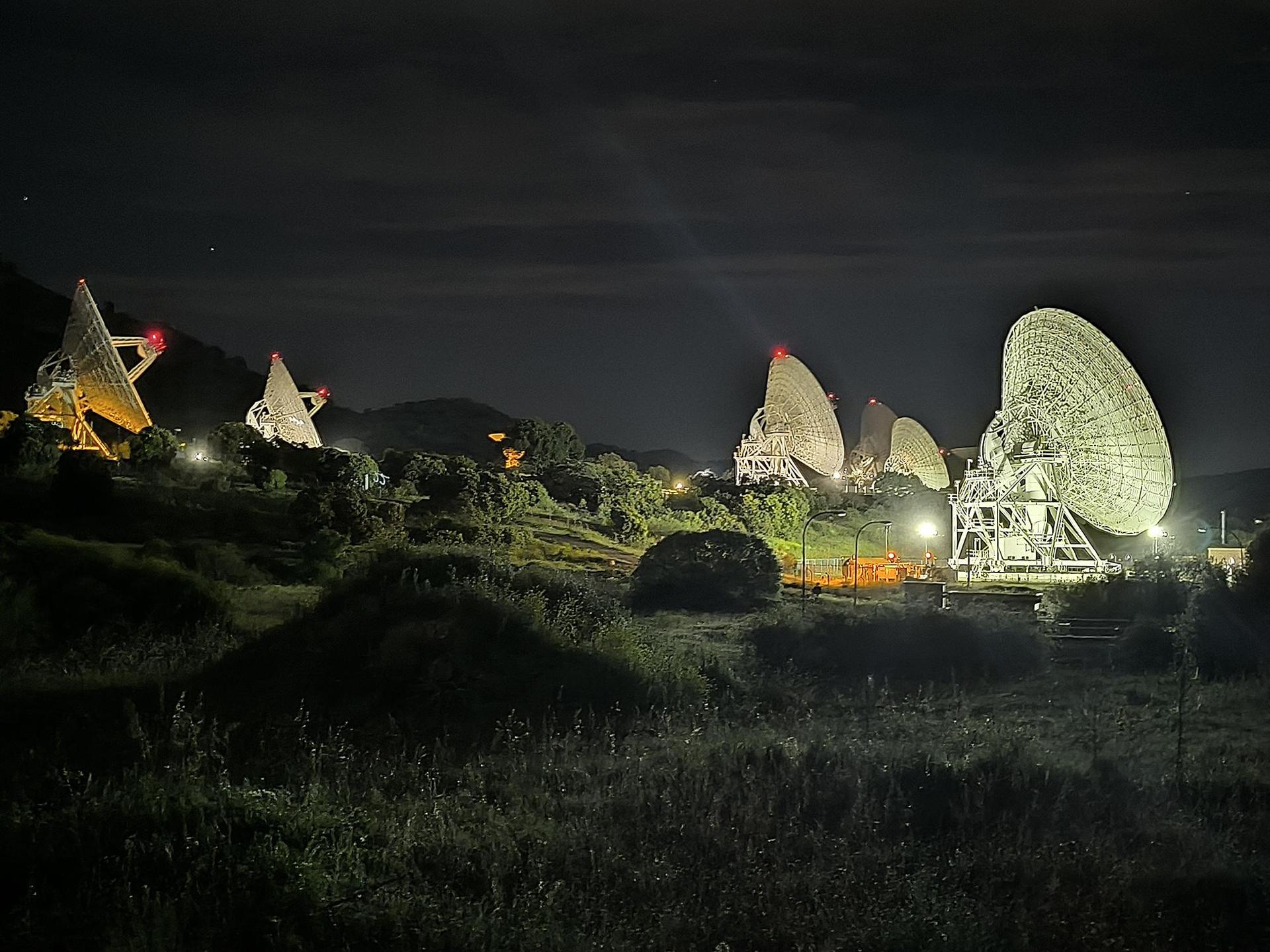
So how do astronomers go about sensing intelligent life today? One way is to listen for signals from space. The technology to do this is daunting. Not only is a large effective aperture required to collect a weak incoming signal, but the possible bandwidth is so broad there are potentially millions of channels in which to listen. In addition, electromagnetic noise generated by human sources poses an increasing interference problem. We assume a civilization communicates using electromagnetic radiation; a sufficiently advanced society might instead use other means beyond our current comprehension.
The SETI project is searching for signs of alien intelligence, using the Allen Telescope Array to collect weak signals from outer space. They were also using the Arecibo Radio Telescope until it collapsed in 2020. Using sophisticated signal-processing methods, they are hoping to extract an intelligent message from the background noise of the universe. So far they have been unsuccessful, but it is a good start. Unfortunately, this project is erratically funded, mostly by a few wealthy benefactors.
Have we already sent our first message?
We have been emitting electromagnetic waves into space since the 1930s, or possibly earlier, that could act like communications beacons. In those eighty to one hundred years or so, there have been ample opportunities for our transmissions to be heard by other life forms of superior intelligence, if they exist.
If our messages have reached a stellar system, it must be no farther than eighty to one hundred light-years away. If we expect an answer in the near future, the source must be no more than forty or fifty light-years away. As of 2026, astronomers have confirmed more than 6,400 exoplanets galaxy-wide, though only about a hundred (thirty-one of which may be rocky, and not all in the habitable zone) are confirmed within roughly fifty light-years of Earth. So far, we have not detected any intelligent signals from outside our solar system.
That does not mean there is no intelligent life within fifty light-years. Our signals would be very weak at any distance outside our solar system. To receive and decode them would require technology exceeding our current capabilities — hence a society more advanced than ours. Return signals could in principle arrive from any direction and any distance.
A cosmic sense of scale
To grasp the challenge of communicating with intelligent life, it helps to look at how long life took to evolve on Earth. Our Sun formed approximately 4.6 billion years ago; Earth condensed from the Sun's nebular disk about 4.5 billion years ago. Life began roughly 3.8 billion years ago as single-celled bacteria. Multicellular life didn't appear until about a billion years later. Oxygen slowly built up in the atmosphere through cyanobacterial photosynthesis, culminating in the Great Oxygenation Event roughly 2.3 billion years ago. Complex life — arthropods, then fish — didn't emerge until about 600 million years ago. Forests followed 200 million years after that, mammals 225 million years after that. Homo sapiens have only existed for about 200,000 years.
Modern communication technology has happened in a blink of an eye by comparison: the telegraph appeared in 1844. Radio was invented in 1895. Commercial radio grew in the 1920s and '30s. The 1940s and the Second World War brought modern signal processing to communications. Video technology was introduced on a mass scale in the 1950s. Directed, high-power microwave and lasers appeared in the 1960s. For the last sixty years man has built vast arrays of antennas and sophisticated communication systems, both on the ground and in space. Wireless communication has existed for a little over one hundred years — roughly 0.000003% of the entire span of life on Earth.
Mass extinctions complicate the picture further. Earth has had at least five, the most famous wiping out the dinosaurs 66 million years ago (likely a meteor impact), and the most severe at the end of the Permian period 250 million years ago, killing over 90% of all species (likely runaway ocean warming from volcanic CO2). Both were essentially random events that could just as easily reset — or never touch — the trajectory of life on another world.
In 1961, Frank Drake devised his famous equation to estimate the number of communicative civilizations in the galaxy. It accounts for many factors. One is the window of time that a civilization can communicate before it closes. Civilizations and their technologies do not last forever. Our window just opened one hundred years ago. Drake's equation, however, has no factor predicting time alignment of exoplanetary communications windows with our own. The timeline for development of intelligent life on an exoplanet might be similar to ours, or not, but when would their communications window open and would it align with ours? A planet that formed at the same time as Earth could easily be tens of millions of years behind or ahead of us technologically. Whether an exoplanet's window lines up with ours is mostly a matter of chance.
How far is too far?
Even a detected signal is only step one — real communication means a two-way exchange. Exoplanets have been found as close as about four light-years and as far as at least 21,500 light-years away. Round trip communications time to the latter would take 43,000 years — clearly impractical for any civilization to sustain.
Consider Kepler-186f, an Earth-like planet roughly 500 light-years away: a round-trip exchange would take a thousand years. Even TRAPPIST-1, at 40 light-years with three planets in its habitable zone, would mean an 80-year round trip. Would a message sent by one generation be answered by another?
A round trip of ten to thirty years seems more realistic, which points to targets five to fifteen light-years from Earth. There are fewer than fifty stellar objects in that range, and only two Sun-like (G-type) stars: Alpha Centauri A (4.3 light-years, similar age to the Sun with a suspected yet unconfirmed planet) and Tau Ceti (12 light-years, about a billion years older than the Sun, two potentially habitable planets, though a debris disk raises concerns about heavy meteor bombardment).
As of 2026 there are fifteen other star systems within fifteen light-years of Earth having known planets. Some may be in the habitable zone of their stars. These systems are all M-type red dwarfs — stars of this type, however, are quite active and may inhibit intelligent life on their planets.
Based on the limited number of nearby candidates and the vanishingly small odds that two civilizations' communication windows would ever align, I would put the chances of establishing real two-way contact in the same ballpark as "seeing a pig fly." We'll probably have to settle for the possibility of a single message, if one ever comes.
Then again, chance may prove me wrong.
John Kern is a Cosmic Herald guest contributor with a longtime interest in astronomy and the search for extraterrestrial intelligence. The views expressed are his own.