
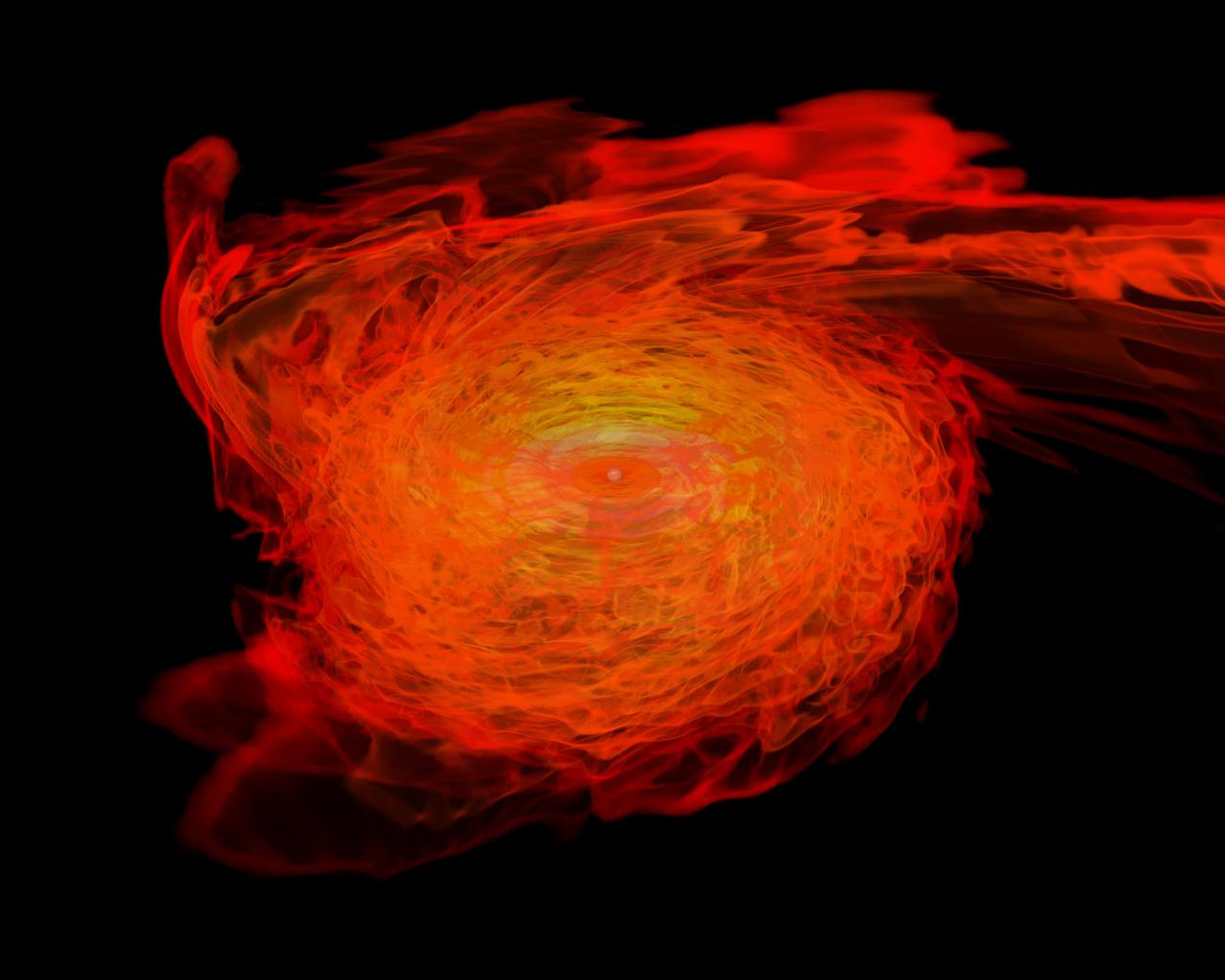
When two black holes merged 1.3 billion light-years away and the LIGO detectors registered the event in September 2015, the instruments were measuring a fractional change in length — a strain — of order 10⁻²¹. Across a four-kilometre arm, that corresponds to a displacement far smaller than the width of a proton. The detection, GW150914, confirmed a century-old prediction of general relativity and won the 2017 Nobel Prize in Physics. That such a measurement is possible at all is the real achievement, and understanding how it is done explains why gravitational-wave astronomy took a hundred years to arrive.
An interferometer built to fight noise
Each LIGO detector is a Michelson interferometer with kilometre-scale arms enhanced by Fabry-Pérot cavities that fold the laser's path to increase its effective length. A passing gravitational wave stretches one arm while compressing the perpendicular one, shifting the interference pattern where the two beams recombine. The principle is almost trivially simple; the difficulty is that essentially every other effect on Earth produces a larger signal. Seismic motion, the thermal vibration of the mirrors' atoms, and the quantum shot noise of the laser itself all have to be suppressed below the 10⁻²¹ level. The answer is a stack of technologies: multi-stage seismic isolation that floats the optics, ultra-low-loss fused-silica test masses, and — increasingly — the injection of "squeezed" light, a quantum trick that beats the shot-noise limit by trading uncertainty between a measurement's complementary properties.
Reading the waveform
A compact binary coalescence produces a characteristic signal called a chirp: as the two bodies spiral inward, the frequency and amplitude of the waves rise, peaking at the moment of merger, followed by a brief ringdown as the newly formed remnant settles into a stable shape. Analysts pull that waveform out of the noise by matched filtering — comparing the data against vast banks of theoretical templates — and from the best-fit template they infer the masses, the spins, and the distance to the source. GW150914 implied two black holes of roughly 30 solar masses each, a population whose very existence was itself a discovery, since stellar-mass black holes that heavy had not been firmly established before.
The multi-messenger payoff
The field's defining moment came in August 2017. GW170817, the inspiral of two neutron stars, arrived with an electromagnetic counterpart: a short gamma-ray burst seconds later, then a kilonova that observatories across the spectrum tracked for weeks. It confirmed neutron-star mergers as a forge for heavy elements, delivered an independent constraint on the speed of gravity to extraordinary precision, and inaugurated multi-messenger astronomy in earnest. With the Virgo and KAGRA detectors joining the network, the sky localisation of events has sharpened, and detections that were once singular are now routine.
Pushing to lower frequencies
Ground-based interferometers are fundamentally limited at low frequencies by seismic and gravity-gradient noise, which caps the masses and orbital separations they can probe. Two complementary approaches extend the reach. Pulsar timing arrays turn the galaxy's millisecond pulsars into a distributed detector, watching for the nanohertz gravitational-wave background produced by supermassive black hole binaries; recent arrays have reported evidence for exactly such a signal. And ESA's planned LISA — three spacecraft in a vast triangle linked by laser, trailing Earth around the Sun — will open the millihertz band, where massive black hole mergers and compact galactic binaries reside, entirely free of terrestrial noise. Each band reveals a different population of sources. Together they are turning the detection of spacetime's own vibrations from a single triumphant note into a full spectrum — a new sense for observing a universe that, until 2015, we could only see.
What the growing catalogue reveals
A decade on, detections number in the hundreds, and the population itself has become a scientific result. The catalogue of merging black holes has revealed objects in mass ranges that stellar evolution struggles to explain — including remnants in the so-called pair-instability mass gap, where theory predicts stars should leave no black hole at all. Each merger also functions as a test of general relativity in the strong-field regime, where gravity is most extreme; so far Einstein's theory has passed every one. And because the rate of detections scales with the cube of a detector's sensitivity, even modest hardware upgrades dramatically expand the volume of space being monitored, which is why successive observing runs have turned a trickle of landmark events into a near-continuous stream.