
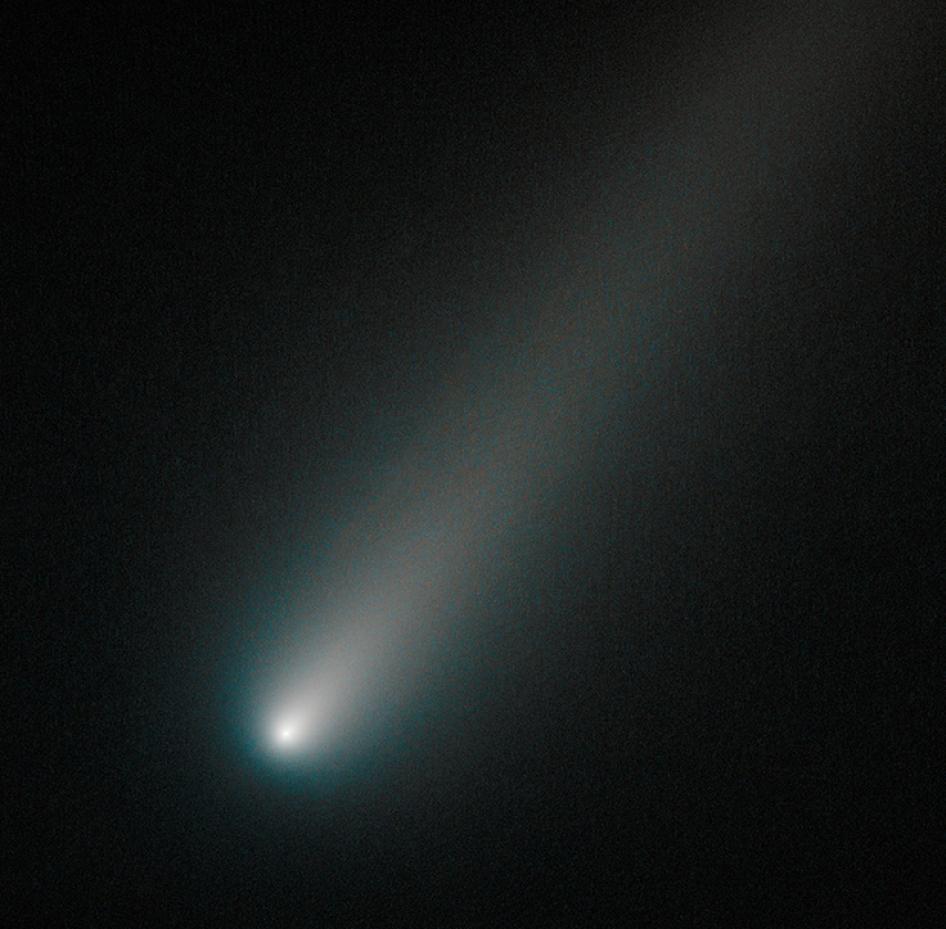
For 27 years, the object cataloged as 1998 SH2 sat quietly in the ledgers as a near-Earth asteroid — one more chunk of rock among the tens of thousands that loop through Earth's neighborhood. It looked like an asteroid. It was filed like an asteroid. And then it moved like something else entirely.
In a study published July 16, 2026 in Nature Astronomy, a team led by NASA's Jet Propulsion Laboratory reclassified the object as an active comet. It now carries a new name that tells the whole story: P/1998 SH2, where the "P" marks it as a periodic comet rather than a lifeless asteroid. The tell wasn't a dramatic flare or a sudden brightening. It was math — subtle deviations in the object's orbit that no gravitational bookkeeping could explain.
How a rock gives itself away
Asteroids are, for the purposes of orbital mechanics, well-behaved. They fall through space along paths dictated almost entirely by gravity — the Sun's, the planets', occasionally each other's. Plug in the masses, run the numbers, and you can predict where one will be years in advance.
Comets cheat. When a comet nears the Sun, buried ice warms, turns to gas, and vents off the surface, dragging dust with it. That venting acts like a series of tiny, uneven thruster firings. Over time, those "nongravitational" accelerations nudge the object off the path pure gravity would carve. It is a small effect — but a persistent one, and a measurable one.
That is exactly what lead author Davide Farnocchia, of NASA's Center for Near-Earth Object Studies at JPL, and his colleagues found. Farnocchia points to the "nongravitational perturbations affecting the motion of 1998 SH2" — the fingerprint of ice and rock venting into space when the Sun heats them. An asteroid has no such volatiles to burn. A comet does. The orbit was, in effect, confessing.
Catching it in the act
Orbital anomalies are a strong hint, but the team wanted to see the thing. That opportunity came on August 28, 2025, when 1998 SH2 made a close approach, passing within roughly 2 million miles of Earth. In cosmic terms that is a comfortable miss — about eight times the distance to the Moon — but in observational terms it was a front-row seat.
The astronomers brought heavy instrumentation to bear. NASA's Deep Space Network planetary radar pinged the object directly, bouncing radio waves off its surface. On the optical side, they enlisted the 3.6-meter Canada-France-Hawaii Telescope, along with two European Southern Observatory facilities in Chile: the venerable Danish 1.5-meter telescope at La Silla and the 8.2-meter Very Large Telescope, one of the most powerful optical instruments on Earth.
The payoff was a detection that would have been easy to miss with lesser equipment. As the JPL release puts it, "the object looks like an asteroid but moves like a comet," and the telescopes settled the question by resolving what the team describes as "a weak but clear tail." Faint, but unmistakably there — the diffuse streamer of gas and dust that only an active comet produces. ESO's Olivier Hainaut was among the co-authors on the observational work.
The object circles the Sun roughly every 4.5 years, which means it has made this passage many times since its 1998 discovery without anyone noticing its true nature. It took a close pass, a suite of world-class observatories, and a careful accounting of its orbit to catch it.
The 'dark comet' problem
P/1998 SH2 is not a one-off curiosity. The JPL team explicitly ties the finding to a broader line of research into so-called "dark comets" — objects that behave like comets, showing nongravitational accelerations, but that don't display the obvious glowing coma and tail we associate with the word. They masquerade as asteroids, sometimes for decades, until someone looks closely enough.
What makes 1998 SH2 notable is that it bridges the two categories. It showed the orbital anomalies of a dark comet — and then, given enough light-gathering power, it also revealed the faint tail that confirms genuine cometary activity. In other words, the outgassing inferred from its motion was corroborated by direct imaging of the material being shed. The circumstantial case and the eyewitness account agree.
Why It Matters
The reclassification is more than a bookkeeping change. It underscores that the line between "asteroid" and "comet" is blurrier than the tidy categories suggest — and that some fraction of the objects currently logged as inert rocks may be quietly venting gas, subtly altering their own trajectories in the process.
That has practical stakes. Accurate orbit prediction is the foundation of planetary defense: to know whether a near-Earth object poses a hazard, you have to know where it will be, sometimes decades out. Nongravitational forces from outgassing introduce a source of drift that a purely gravitational model will get wrong. An object mislabeled as an asteroid could, over many orbits, wander from its predicted path by amounts that matter. Identifying which objects are secretly active — and by how much they're being pushed — tightens those forecasts.
There's a scientific dividend too. Every dark comet that gets unmasked is a data point on how volatile ices survive in the inner Solar System and how objects transition between dormant and active states. P/1998 SH2, with its 4.5-year orbit and now-known activity, becomes a repeatable target — one astronomers can revisit pass after pass to watch a comet caught mid-disguise.
Mostly, it's a reminder that a catalog entry is a hypothesis, not a verdict. An object watched for 27 years still had something to hide. It took modern radar, three of the planet's most capable telescopes, and a patient reading of its own orbit to draw it out.