
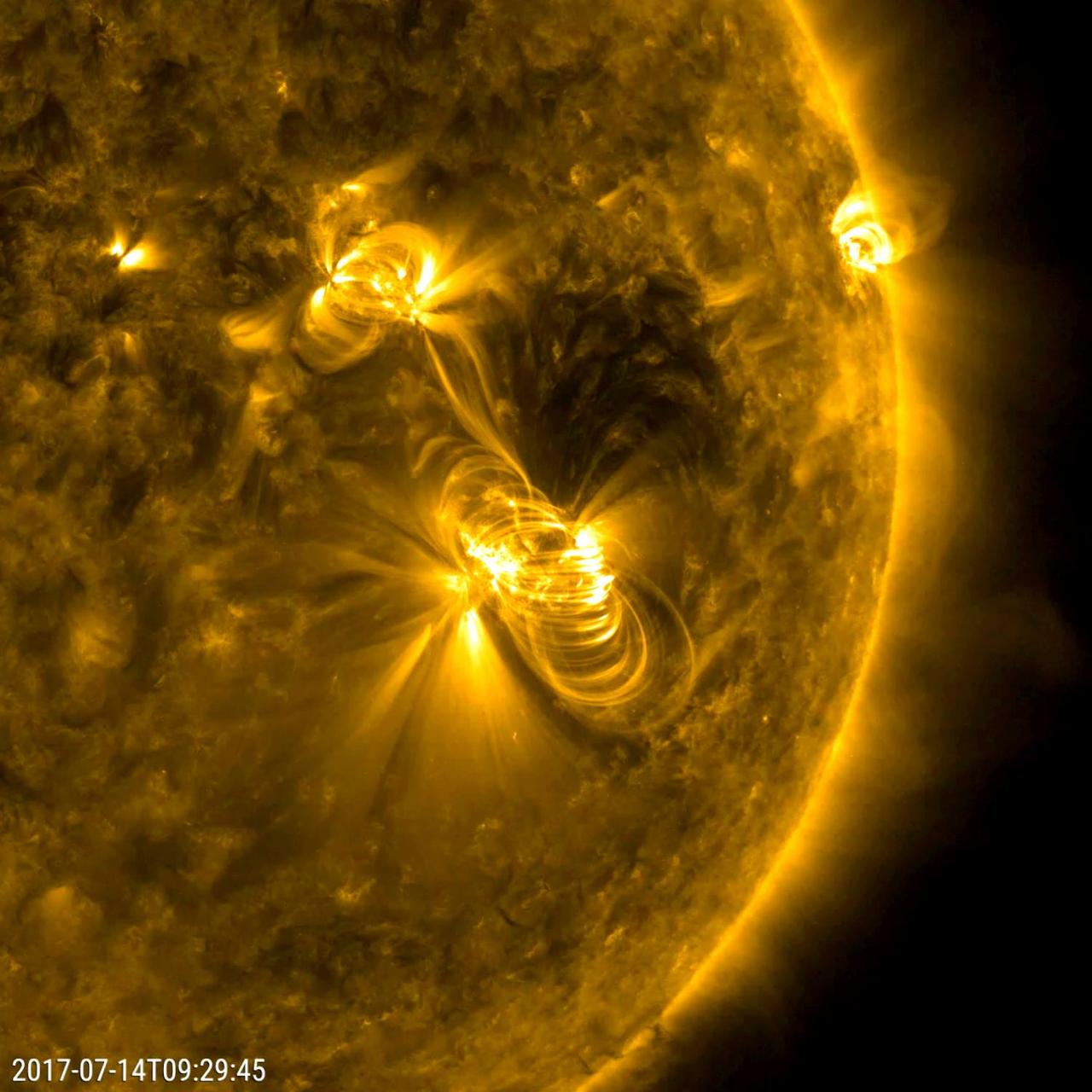
For decades, space weather forecasters have leaned on a comforting idea: no matter how violently the sun rages, Earth's magnetic field and upper atmosphere can only be pushed so hard. Past a certain point, the thinking went, the geomagnetic response to an incoming solar storm "saturates" — it plateaus, refusing to get much worse no matter how strong the solar wind driving it becomes. That assumption has shaped how engineers size the margins on power grids, satellite electronics, and navigation systems for years.
A new study led by NASA Goddard Space Flight Center physicist Dr. Nithin Sivadas, published in Nature, argues that ceiling was never really there. It was a mirage built out of measurement uncertainty.
What the data actually showed
The research team combed through more than one million individual solar wind measurements, comparing readings from spacecraft stationed roughly a million miles from Earth against data from satellites orbiting much closer in — including NASA's MMS (Magnetospheric Multiscale) mission and the THEMIS constellation. Those distant monitors are imprecise by nature: measuring a stream of charged particles from a million miles away introduces a fair amount of statistical noise into any single reading.
When the team accounted for that noise and cross-checked it against the more reliable, close-in satellite data, the "saturation" pattern that has shown up in decades of geomagnetic storm records changed character entirely. Instead of a response curve that flattens out as solar wind strength increases, the corrected data revealed something closer to a straight, unbroken relationship — the harder the solar wind hits, the harder Earth's upper atmosphere responds, with no sign of an upper limit within the range of storms studied.
In statistical terms, the paper's title spells out the culprit directly: "Regression to the mean can explain saturation of geomagnetic storms." Regression to the mean is a familiar trap in data analysis — when a variable is measured with error, extreme values on one axis tend to get paired with less extreme values on the other, purely as an artifact of that error, creating the appearance of a leveling-off effect. Apply that lens to solar wind data collected from a spacecraft a million miles out, and a real, unbroken relationship between storm strength and atmospheric current can look like it caps out — even when it doesn't.
A Q&A on what this means
So Earth's magnetic shield doesn't actually protect us from the biggest storms?
It still does a great deal of protecting — that's not in dispute. As co-author Dr. Maria Walach of Lancaster University put it: "Our planet's magnetic field does a really great job of protecting us against many space weather effects." What's changed is the assumption about how that protection scales during the most extreme events. Rather than the magnetosphere capping the damage once storms cross a certain intensity, the new data suggest the response keeps climbing right alongside the storm's strength.
Why does this matter for real-world infrastructure?
Geomagnetic storms already have a track record of disrupting satellite communications, causing extensive power outages, and elevating radiation exposure for astronauts and pilots. If forecasting models have been built around a ceiling that doesn't actually exist, the worst-case scenarios used to plan grid resilience, satellite shielding, and aviation rerouting during major storms may be underestimating just how bad things could get.
Is this settled science now?
Not entirely. The NASA Goddard team is calling for more direct observations during genuinely strong solar wind events to confirm the pattern holds at the most extreme end of the scale — the very events that matter most for infrastructure risk are also the rarest, and thus the hardest to pin down statistically. As Dr. Maria Walach put it, "these very extreme cases are rare, but this also means we have limited data to work with and only time will tell what happens at the very extreme one-in-a-thousand-year kind of event." Sivadas summed up the stakes plainly: "Space weather risks appear underestimated."
Why It Matters
Space weather forecasting isn't an academic exercise — it underpins decisions about how much shielding to build into satellites, how utilities prepare grid equipment for geomagnetically induced currents, and how airlines route polar flights during solar storms. All of that planning has, to some degree, rested on the assumption that there's a practical ceiling to how severe the atmospheric response to a solar storm can get. If that ceiling is instead a statistical artifact of noisy, distant measurements, then the true worst-case for a major geomagnetic storm could exceed what current models anticipate. For an increasingly satellite-dependent, grid-reliant world, closing that measurement gap with better observations during extreme events isn't just a scientific curiosity; it's a risk-assessment problem with real infrastructure stakes.