
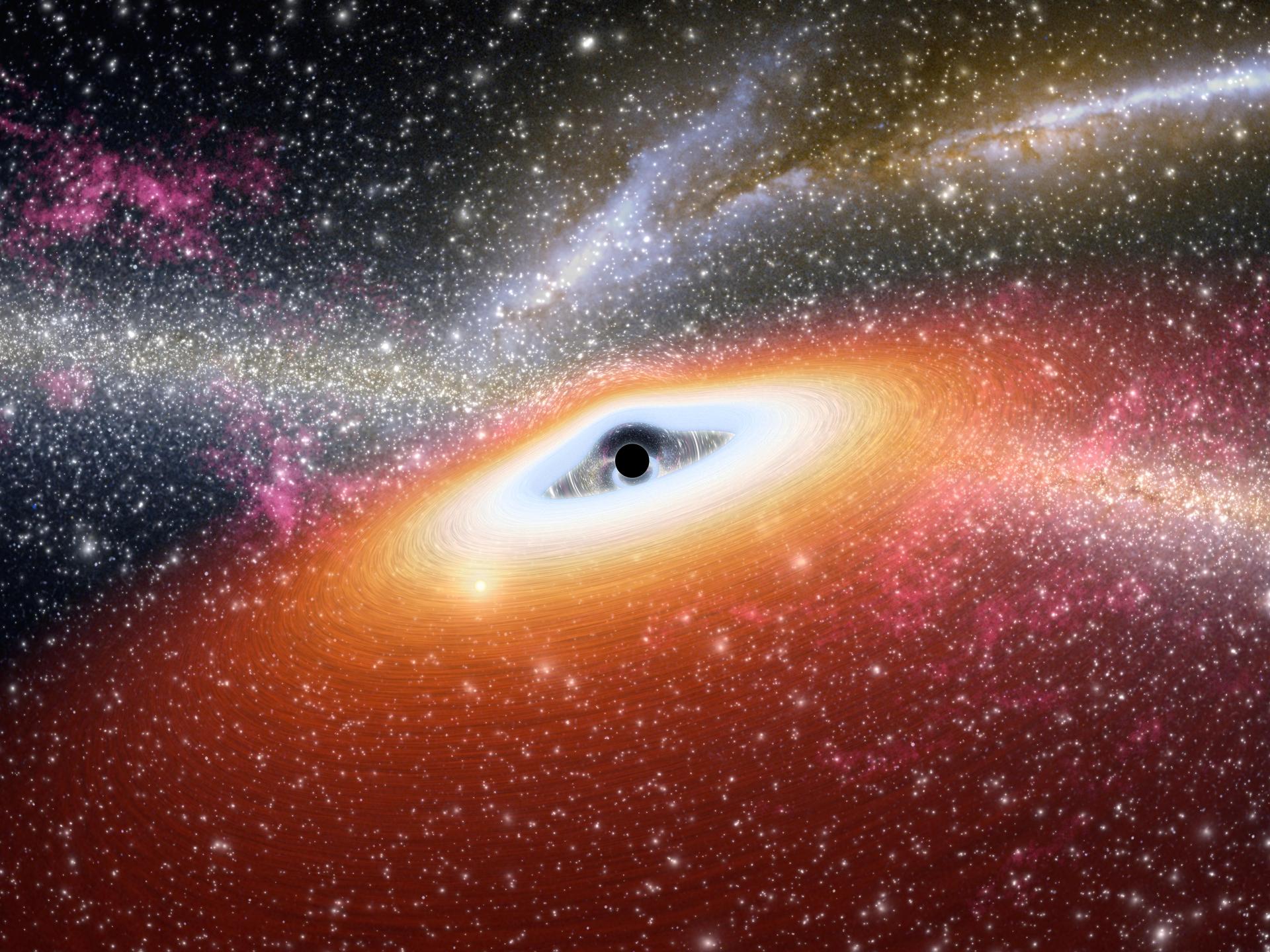
Dark matter has been the universe's most stubborn open case for decades. It outweighs ordinary matter by roughly five to one, it shapes the rotation of galaxies and the clumping of cosmic structure, and it has never once shown up in a detector built to catch it. Every major hunt — underground xenon tanks, particle colliders, space telescopes scanning for exotic decay signatures — has come back empty. So when a new candidate shows up, especially one that doesn't require inventing a new particle, it's worth a second look.
The latest candidate is not new physics at all. It's old physics — older, in fact, than the universe itself. In a paper published in Physical Review D (Vol. 113, Issue 4), University of Portsmouth cosmologist Enrique Gaztañaga, working with the Institute of Space Sciences in Barcelona, argues that black holes formed before the Big Bang could have survived into the present universe and could be the dark matter that astronomers have been chasing all along.
A Universe That Bounced Instead of Banged
The standard picture of cosmic origins starts with a singularity: all of space, time, and matter compressed into an infinitely dense point, followed by the explosive expansion we call the Big Bang. Gaztañaga's model swaps that starting gun for something stranger. In this "cosmic bounce" scenario, our expanding universe was preceded by an earlier universe that was contracting — collapsing in on itself. Instead of crushing down to a singularity, that collapse reversed course and rebounded into the expansion we now observe.
The idea itself isn't unique to this paper; bounce cosmologies have circulated in theoretical physics for years as an alternative to the standard Big Bang framework, largely as a way to sidestep the singularity problem. What Gaztañaga's research adds is a specific, testable consequence: if black holes existed in that prior contracting universe, would they survive the bounce, or would the phase transition destroy them along with everything else?
According to the study, size is what determines survival. Compact objects larger than roughly 90 meters across could make it through the bounce transition intact, emerging into our universe as relics — what the researchers call "cosmic fossils." Anything smaller wouldn't survive the crossing.
Why Black Holes as Dark Matter Fits
The pitch is elegant precisely because it doesn't require any exotic new particle. Dark matter needs to be massive, gravitationally interactive, and largely invisible to light — and a black hole is, by definition, exactly that. Primordial black holes as a dark matter candidate have been proposed before, usually framed as objects that formed from density fluctuations in the very early Big Bang universe. Gaztañaga's contribution pushes the formation epoch back further still, into a universe that predates our own by the bounce itself.
There's a second selling point buried in the model: it could help resolve a genuine puzzle that has been nagging astronomers since the James Webb Space Telescope came online. JWST has repeatedly spotted unexpectedly massive black holes anchoring galaxies in the early universe — objects sometimes nicknamed "little red dots" that appear to be rapidly growing black holes that showed up surprisingly soon after the Big Bang, seemingly too big to have grown that massive that fast under conventional formation timelines. If some black holes are relics that predate the Big Bang rather than products of it, that head start could help explain how they got so big, so early. Coverage of the study also notes the model could bear on gravitational-wave backgrounds, another area where the theory generates predictions that future observations could test.
What This Isn't (Yet)
It's worth being precise about what has actually been published. This is a theoretical proposal in a peer-reviewed journal, not a detection. Nobody has found a 90-meter-plus black hole and traced its lineage to a pre-bounce universe; the paper establishes that such objects could survive the transition and could account for the dark matter budget, not that they do. Bounce cosmology itself remains a minority, alternative framework relative to the standard inflationary Big Bang model, and any dark matter candidate — primordial black holes included — still has to clear a gauntlet of existing observational constraints before it can be taken as more than a viable hypothesis.
What makes the idea worth tracking rather than dismissing is that it generates predictions that can, in principle, be checked against real data: the study points to relic gravitational-wave signals from the pre-bounce phase, and to exactly how early and how massive JWST's most extreme black holes turn out to be as more of them are catalogued.
Why It Matters
Dark matter searches have spent the better part of two generations betting on exotic particles — WIMPs, axions, sterile neutrinos — and none of them have panned out despite enormous experimental investment. A model that instead points to black holes, objects we already know exist and already understand gravitationally, is attractive precisely because it doesn't ask physics to invent a new particle from scratch. It also ties two separate puzzles together: the identity of dark matter and the anomalously early, anomalously massive black holes JWST keeps finding. If a single mechanism explains both, that's the kind of unifying result cosmology prizes highly. The catch is that "could explain" is doing a lot of work in that sentence — this is a mathematically consistent proposal, not a confirmed source of dark matter, and it will live or die on whether upcoming gravitational-wave and lensing data line up with what a population of pre-Big-Bang relic black holes should look like.