
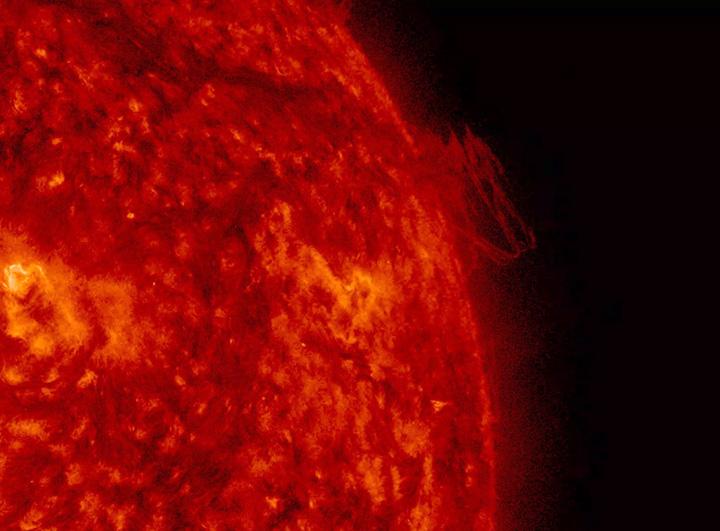
The Sun's surface has never looked quite like this. Using the Daniel K. Inouye Solar Telescope on Maui, an international team has photographed plasma vortices roughly 20 kilometers across — tiny, swirling whirlpools of hot gas that no instrument had ever been sharp enough to resolve before. The result, published in Nature, sits at what the researchers describe as the literal resolution limit of the world's largest solar telescope.
The team was led by David Kuridze, with the observations built around the Inouye telescope's broadband imaging camera operating at 416 nanometers — a wavelength engineered by the Max Planck Institute for Solar System Research (MPS) specifically to pull fine structure out of the solar photosphere. What it found was a population of small-scale vortices threading through the boiling, cellular pattern of solar granulation, the constantly churning convective cells that carry heat up from the Sun's interior.
How Small Is 20 Kilometers, Really?
On a body 1.4 million kilometers across, 20 km sounds like nothing — and that's precisely the point. According to ScienceDaily's coverage of the release, the vortices are dwarfed by the granules they ride within, which typically span 500 to 2,000 km. Michiel van Noort of MPS offered a comparison that puts the achievement in perspective: finding one of these vortices is akin to spotting a single one-euro coin from 180 kilometers away. That the Inouye telescope managed it at all is a statement about how far ground-based solar imaging has come in a short span of time.
The vortices themselves aren't a total surprise in principle — solar physicists have long predicted that turbulent convection should spin up small rotating structures, much as water spinning down a drain forms a vortex. The research team interprets many of the newly observed vortices as Kelvin-Helmholtz instabilities, a well-studied fluid-dynamics process in which plasma flows moving at different speeds develop shear that rolls up into swirling motion. What's new is direct observational proof at this scale: fine-grained, fleeting features embedded in the churn of the photosphere, resolved for the first time by the Inouye telescope.
Why It Matters
Vortices like these aren't just a curiosity of resolution — according to the research team, they may help answer two open questions about how the Sun manages its own magnetic field. The vortices appear to offer a persistent mechanism for twisting the Sun's magnetic field lines, one of the processes thought to build up the stored magnetic energy that later gets released in small-scale eruptions called nanoflares. Separately, because the vortices are effective at mixing magnetized and non-magnetized plasma, they may also help speed the transport of magnetic field material through the solar atmosphere — a process potentially connected to the roughly 11-year rhythm of the Sun's activity cycle. Sami K. Solanki, director at the Max Planck Institute for Solar System Research, framed the discovery in those terms, saying the vortices "impressively demonstrate how minute processes — at the limit of what we can resolve using all available techniques — significantly determine the nature of our star." Confirming that such structures exist at the smallest observable scales — and are apparently common — gives modelers a concrete, measured input rather than a theoretical placeholder. It also demonstrates that current-generation solar telescopes are now bumping against a genuine physical floor of visibility, meaning the next leap in understanding solar micro-dynamics will likely require either new instrumentation or clever statistical inference from data we can only partially resolve today.
A Multi-Institution Effort
The paper credits collaborators from the NSF's National Solar Observatory, the Max Planck Institute for Solar System Research in Germany, and the High Altitude Observatory in the United States — a spread that reflects how solar physics increasingly depends on shared, expensive infrastructure. The Inouye telescope, operated by the National Solar Observatory, is the largest solar telescope on Earth. Its roughly 4-meter aperture is what made picking out 20-km features possible in the first place.
The observations behind the paper align with what Space.com highlighted as its Photo of the Day for August 10, 2026: an image described as the sharpest picture of the Sun ever captured, underscoring that this isn't an incremental improvement in image quality but a step change in what's visible on the solar surface.
What Comes Next
A single detection at the resolution limit raises as many questions as it answers. Researchers will want to know how common these vortices are across different regions of the Sun, how long they persist, whether they cluster near magnetic field concentrations, and how much energy they actually carry through the magnetic field. None of that is settled by this paper alone — it establishes that the vortices exist and are observable, which is the necessary first step before anyone can measure their role in the Sun's magnetic behavior with confidence.
For now, the discovery stands as a demonstration of what the Inouye Solar Telescope was built to do: push observational solar physics down to scales where theory and prediction finally meet direct evidence.