
More than two months after a New Glenn rocket erupted into flames on the pad at Cape Canaveral, Blue Origin says it has found the culprit: a single balky valve.
In a statement released August 5, followed by additional detail August 6, the company said investigators traced the May 28 explosion to a main oxygen valve failure on one of the seven BE-4 engines powering New Glenn's first stage. The finding closes out a costly and closely watched failure investigation — one that destroyed not just a rocket but 48 Amazon Leo broadband satellites riding on top of it.
What Actually Happened
The vehicle was lost during a static-fire test at Launch Complex 36, a standard pre-launch procedure in which the engines are briefly ignited while the rocket stays clamped to the pad. Instead of a clean shutdown, the test ended in an explosion that destroyed New Glenn and its entire satellite payload.
Blue Origin says the root cause was isolated to the main oxygen valve on one BE-4 engine. The company reached that conclusion through two lines of evidence: recovered hardware pulled from the wreckage, and follow-up hotfire tests run on individual components and full engines to reproduce the failure mode.
"The anomaly originated at the main oxygen valve on one of the BE-4 engines, which was later confirmed by hardware recovery and inspections," CEO Dave Limp said in the investigation statement.
Q&A: What Comes Next
When does New Glenn fly again?
Blue Origin is targeting a return to flight before the end of 2026, though the company has not committed to a specific launch date. Modified valve hardware is expected to be ready by late August, which would leave several months for integration, testing and a new static fire before any launch attempt.
What about the Moon lander?
Collateral damage extends beyond the rocket. Blue Moon Mark 1, the uncrewed lunar lander known as Endurance, was originally targeted to fly around the end of summer 2026 but has slipped to a first-quarter 2027 launch at the soonest. Blue Origin has not stated a reason for the delay, though the timing coincides with the company's ongoing work on the BE-4 fix and New Glenn's return to flight.
Does this affect other rockets?
Yes. BE-4 isn't exclusive to New Glenn — United Launch Alliance's Vulcan rocket also flies on the engine, built by Blue Origin and supplied to ULA. Blue Origin has confirmed it will make the same valve modifications to Vulcan-bound BE-4 engines, with retrofit work happening at ULA's Decatur, Alabama manufacturing plant and at Cape Canaveral facilities. Neither company has detailed whether any specific Vulcan-assigned engine exhibited the same failure mode found in the New Glenn accident, but the shared engine design means Vulcan's own schedule is now tied to the same fix.
Is this the full story?
Not quite. SpaceNews, corroborating Blue Origin's account, noted that Blue Origin has not provided an updated schedule beyond its general end-of-2026 target, and the company's own public statements have stopped short of detailing exactly how the valve failed — whether it stuck open, stuck closed, leaked, or fractured — or what design change fixes it. For a company that has spent years building credibility as a reliable heavy-lift alternative to SpaceX, the level of technical transparency in the coming weeks will matter as much as the hardware fix itself.
The Bigger Picture
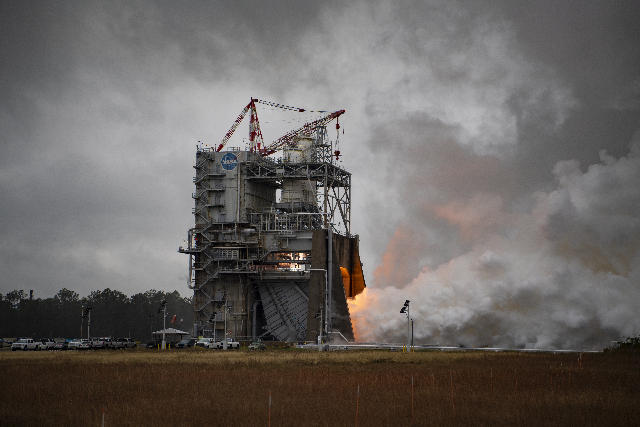
The timing is notable. Just weeks before the explosion investigation concluded, NASA and Blue Origin announced a separate agreement to put New Glenn's second stage through hot-fire testing on the B-2 stand at Stennis Space Center starting this fall. NASA says that testing supports its broader goal of returning astronauts to the Moon and establishing a lunar base near the South Pole, including the Blue Moon Mark 1 lander slated to deliver NASA payloads to the Shackleton Connecting Ridge for the Artemis IV and V missions. The testing is unrelated to the first-stage BE-4 failure — the second stage runs on two BE-3 engines, each producing 200,000 pounds of thrust in vacuum, not the BE-4s implicated in the pad explosion. But it underscores how much NASA's near-term lunar plans now run through New Glenn's hardware maturing on schedule.
NASA Administrator Jared Isaacman framed the Stennis arrangement as part of a broader commercial space race, saying that "winning the new space race means moving faster and working alongside a strong commercial industry" — though the agency's own announcement predates the valve finding by nearly two weeks, a reminder that NASA's exploration timeline and Blue Origin's rocket-reliability timeline are now tightly, if awkwardly, coupled.
Why It Matters
New Glenn is still a young rocket, and this is exactly the kind of failure a young rocket program is supposed to survive: identify the defect, fix the hardware, fly again. What makes it consequential is the blast radius. Amazon lost 48 satellites it needs to build out Leo, its answer to Starlink, at a moment when SpaceX's constellation has years of head start. Blue Origin lost months of schedule on a lunar lander NASA is counting on for Artemis. And because BE-4 is a shared engine, a defect traced to New Glenn's hardware has already reached into ULA's Vulcan program, a rocket the Pentagon and other customers depend on for national security launches.
A single valve, in other words, touches a commercial broadband constellation, NASA's return to the Moon, and a chunk of the country's national security launch capacity. That's the real cost of a still-maturing rocket supply chain where a handful of companies — and in BE-4's case, a single engine design — sit underneath multiple, unrelated missions. Blue Origin's ability to nail down not just the immediate fix but the underlying design flaw, and to do so with enough transparency that ULA and NASA can plan around it, will say a lot about whether New Glenn is ready for the cadence everyone is now depending on.