
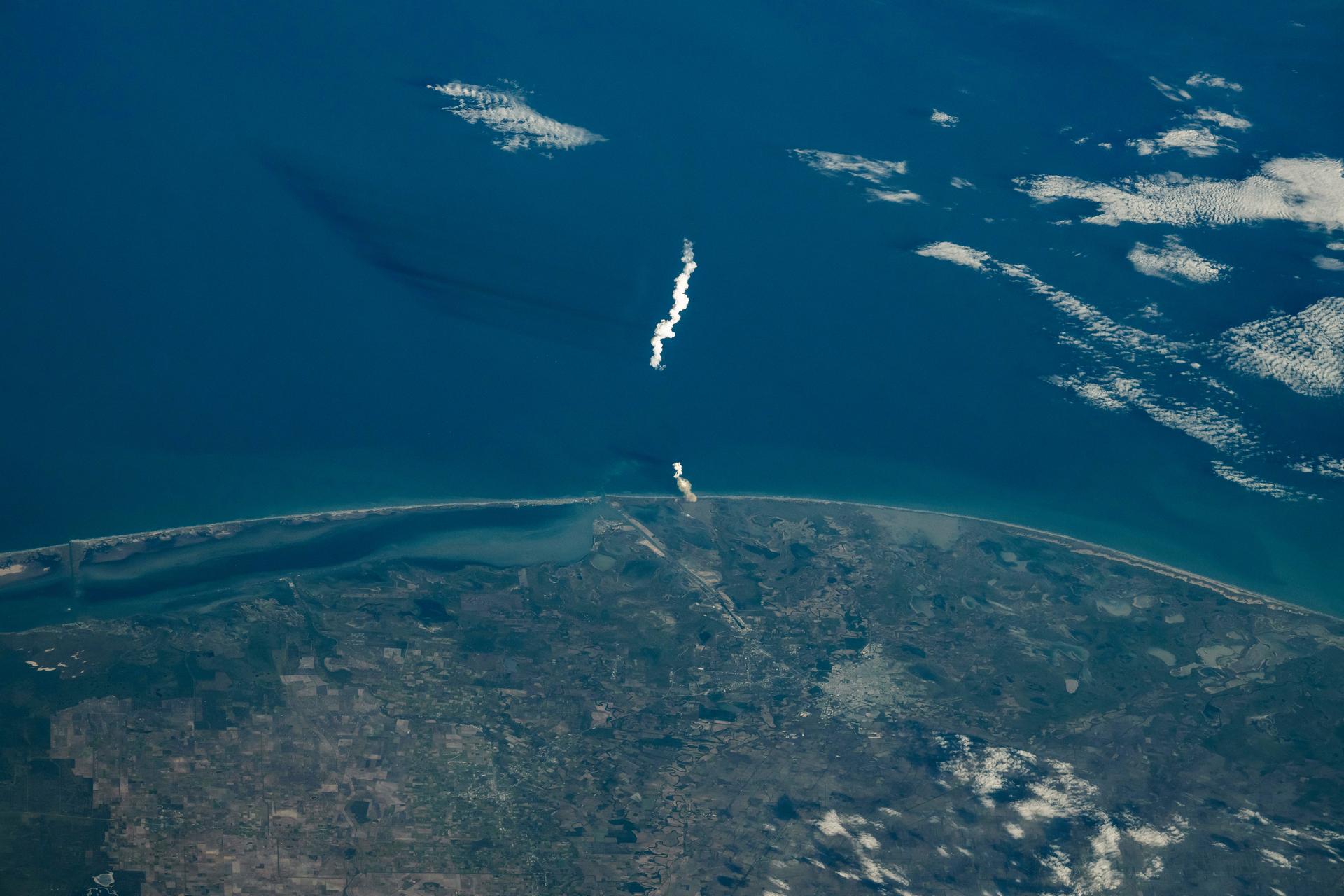
Late on the night of September 20, a Super Heavy booster designated B21 made the short, slow crawl from its integration bay to the launch mount at Starbase, Texas. About two hours later it was standing upright on Pad 2, waiting on a flight that SpaceX has never actually flown before: an orbital one.
Every previous Starship test — thirteen of them — has been suborbital by design, arcing partway around the planet before splashing down in the Indian Ocean. Flight 14, also referred to internally as Starlink 31-1, is meant to close that gap. SpaceX confirmed the rollout in a post on X the same day the booster reached the pad, according to a report from Space.com. The company is targeting no earlier than September 28 at 7:15 a.m. CDT, per Spaceflight Now's reporting on the milestone.
What's Actually Flying
B21 is not a small piece of hardware. Spaceflight Now puts it at 236 feet (72 meters) tall and 9 meters in diameter. Stacked on top of it is upper stage S41, itself 171 feet (52 meters) tall. S41 already cleared a 60-second static fire test on August 21, the kind of long-duration burn SpaceX uses to validate engine health before committing to flight, igniting all six of its Raptor engines. Bolted together, the full vehicle reaches 408 feet (124 meters), according to Space.com.
The payload is where this flight departs most sharply from its predecessors. Rather than a mass simulator or no payload at all, S41 is carrying 26 Starlink V3 satellites, each rated for roughly 1 Tbps of capacity, according to Spaceflight Now. The plan calls for deployment into an orbit roughly 171 miles (275 km) up, inclined 30 degrees to the equator. Elon Musk has said the V3 generation is meant to eventually scale the Starlink constellation to around 100,000 satellites, per Space.com's reporting — a figure that, if it ever materializes, would dwarf every satellite constellation flown to date combined.
Two Splashdowns, One New Ocean
The flight profile itself reads like a choreography of controlled falls. Roughly seven minutes after liftoff, Super Heavy is expected to come down for a splashdown in the Gulf of Mexico, per Space.com's account of the mission plan. The ship continues on, deploys its Starlink payload, and then — rather than reentering after a single partial orbit as prior test flights have — circles the Earth about six times before attempting a splashdown in the Pacific Ocean off the coast of Chile, roughly 10 hours after launch.
That Pacific target is new. Every previous suborbital Starship test has ended in the Indian Ocean. The shift matters enough that it required its own environmental review: the FAA's own page on the Starship Super Heavy program confirms the agency completed a Final Tiered Environmental Assessment along with a Finding of No Significant Impact and Record of Decision covering "SpaceX Starship Reentry Contingency Operations in the Pacific Ocean and Additional Starship Landing Trajectory." That document is the regulatory groundwork underpinning Flight 14's new splashdown zone.
The Regulatory Hurdle Still Ahead
Environmental clearance is only part of what SpaceX needs before B21 and S41 can fly. Spaceflight Now reports that the FAA must still approve a modification to Starship's orbital launch license — and that this will be the first time the agency has licensed an object of Starship's size for orbital operations, as opposed to the suborbital hops flown so far.
The FAA's Office of Commercial Space Transportation licenses launch operations like this one under the Commercial Space Launch Act, codified at 51 U.S.C. §§50901–50923. The review the office runs covers public safety, national security and foreign policy considerations, insurance requirements, and environmental impact — the same four-part framework that governs every licensed U.S. commercial launch, now being applied to a vehicle bigger than anything the office has certified for orbit before.
Why It Matters
Starship has flown thirteen times without ever actually going to orbit, which has left a persistent asterisk on the program's most dramatic footage: fast catches, successful reentries, and dramatic hover-and-landing demonstrations, all performed on trajectories that never carried real risk of leaving something in space. Flight 14 removes that asterisk. A vehicle that reaches orbit and deploys operational satellites is a vehicle that can start generating revenue and replacing expendable capacity, not just proving out engineering milestones.
The Starlink V3 payload sharpens the stakes further. At a claimed 1 Tbps per satellite, these are meant to be the backbone of a constellation Musk has pegged at roughly 100,000 spacecraft — a scale that is not reachable on Falcon 9's cadence and satellite-per-launch economics. Starship's ability to loft two dozen-plus heavy satellites per flight is the entire premise behind that number.
And the FAA's involvement is not a formality. The agency's still-pending approval of orbital operations for the largest rocket ever assembled — its first for a vehicle of this size — will set a regulatory precedent that shapes how quickly SpaceX, and eventually any competitor building at this scale, can move from test flights to routine orbital launch cadence. The Pacific splashdown zone, cleared through a dedicated environmental review, is a preview of the kind of case-by-case regulatory groundwork every future Starship mission profile will likely require.