
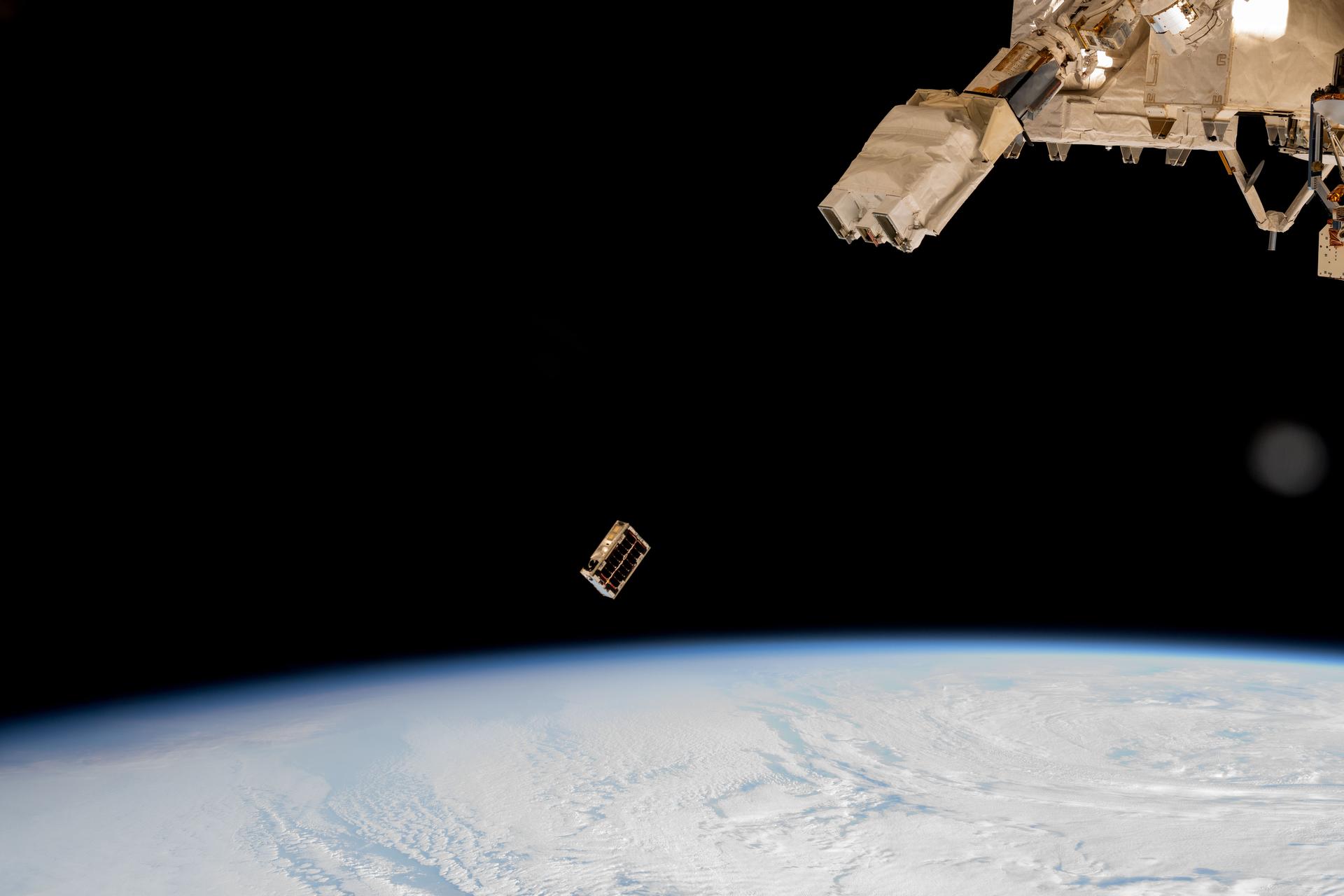
Suppose a country decided to break the oldest rule in spaceflight and quietly park a thermonuclear warhead in orbit. How would anyone else find out? For decades the honest answer has been: probably not, at least not with confidence, and not with a method you could defend in a courtroom or an arms-control forum. A paper published July 16, 2026 in Nature sets out to close that gap, and it does so with a satellite small enough to hold in two hands.
The work comes from Areg Danagoulian, an MIT nuclear physicist who specializes in non-proliferation, and it was funded in part by the U.S. National Nuclear Security Administration. What Danagoulian and colleagues describe is, by their framing, the first peer-reviewed technique for actually identifying a nuclear weapon hidden among the tens of thousands of objects circling the planet. The instrument is a 9U CubeSat carrying a neutron detector; the physics it leans on is the same brutal radiation environment that spacecraft engineers usually treat as a hazard to be shielded against.
The trick: turn the Van Allen belts into a floodlight
Fissile material inside a warhead is not silent. It emits neutrons, but on its own the signal is faint against the noise of space, and a shielded weapon can be made fainter still. The clever part of the proposal is that it does not wait passively for that whisper. Instead, it exploits the Van Allen radiation belts — the doughnut-shaped regions of charged particles trapped by Earth's magnetic field — as a natural source of illumination.
High-energy particles from the belts slam into the dense nuclei of a warhead's fissile core and knock loose bursts of neutrons in a process called spallation. Those spallation neutrons carry a signature that a purpose-built detector can pick out. In effect, the belts do the interrogating; the CubeSat just has to be close enough to read the answer. The detector itself pairs a plastic neutron scintillator with a single-crystal diamond detector — a combination chosen to register the spallation neutrons cleanly in a punishing radiation background.
That reliance on the belts is also the method's sharpest limitation. It only works inside the Van Allen environment, roughly out to the ~2,000 km altitude that defines the upper reaches of low Earth orbit. A warhead stashed well above the belts, or in some other regime, would not be lit up the same way, and the technique would lose its floodlight.
How close, and for how long
Detection is a race between proximity and time, and the paper is refreshingly specific about the tradeoff. The neutron signal falls off steeply with distance, so how long an inspector satellite must loiter depends heavily on how near it can get.
- At a range of about 4 km, the CubeSat needs roughly a week of observation to build confidence.
- Close the gap to about 1 km and the detection window shrinks to roughly an hour.
- Field a constellation — the authors model about 10 satellites — and you can cover a target in the neighborhood of 15 hours.
The scaling tells you what an operational version would look like. A single spacecraft creeping to within a kilometer of a suspect object is a slow, deliberate rendezvous. A fleet trades that patience for coverage, letting inspectors sweep more of the sky in less time without having to nose up against every candidate. Either way, this is not a passive stare from afar; it is close-in inspection, with all the orbital-mechanics and diplomatic friction that implies.
What it cannot do
Danagoulian's group is candid about a second, thornier limit. The detector senses fissile material — it does not read intent. An offline nuclear reactor and a weapon can look uncomfortably alike from a neutron-counting standpoint, and the paper acknowledges it cannot cleanly distinguish a dormant reactor from a warhead. That matters because space is trending nuclear for entirely legitimate reasons: fission power concepts and radioisotope systems are being pitched for everything from lunar surface power to deep-space propulsion. A tool that flags "fissile material present" is useful, but it is not a lie detector for weaponization.
Why It Matters
The 1967 Outer Space Treaty bans placing weapons of mass destruction in orbit — a bright legal line that has held for more than half a century largely because nobody had a strong incentive, or an easy path, to cross it openly. The uncomfortable feature of that regime is that it has never come with a good enforcement mechanism. There is a rule, but there has been no reliable way to verify compliance if a state chose to cheat quietly.
That gap stopped being academic amid reports of a Russian nuclear anti-satellite concept — a weapon whose whole point would be to detonate in orbit and cripple satellites across a wide swath of space. A treaty you cannot verify is only as strong as the goodwill of every signatory, and goodwill is exactly what erodes first in a crisis. A peer-reviewed, physically grounded detection method changes the calculus: it offers, at least in principle, a technical basis for saying "we can check." That is the difference between an aspiration and a deterrent.
It is worth being clear-eyed about the caveats. This is a proposal validated on paper and in modeling, not hardware flying today, and its two hard limits — it works only inside the Van Allen belts, and it cannot tell a shut-down reactor from a bomb — bound how far the concept can be pushed. But the direction of travel is significant. Verification technology tends to shape what arms-control agreements are even possible to negotiate; you cannot bargain over what you cannot measure. By giving inspectors a plausible instrument, this work expands the menu of enforceable commitments in orbit at precisely the moment the taboo against weapons in space is under the most strain it has faced in a generation.