
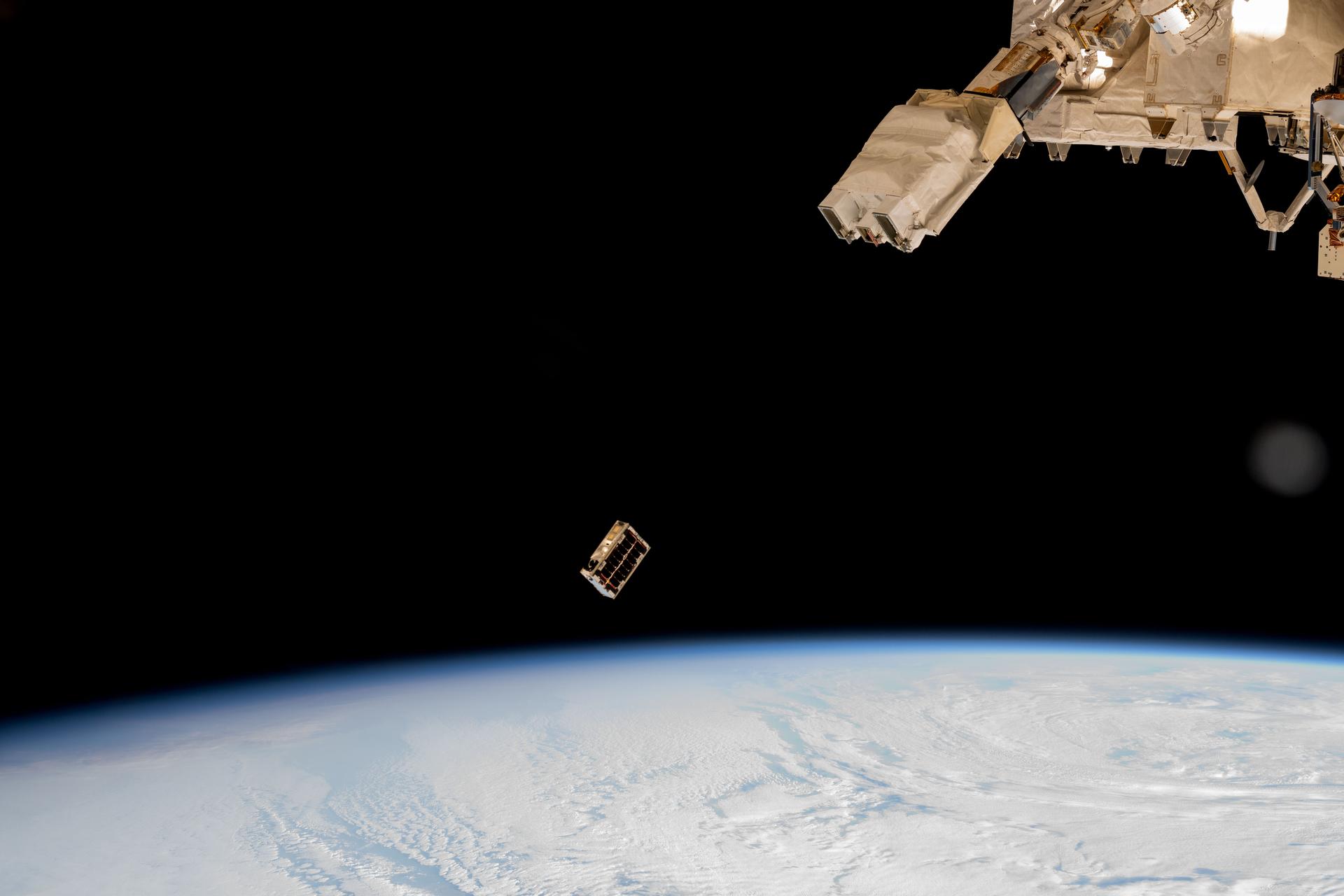
A SpaceX Falcon 9 lifted off from Space Launch Complex-4E at Vandenberg Space Force Base at 1:32 p.m. PDT on July 16, 2026, carrying 21 satellites built by York Space Systems for the Pentagon's Space Development Agency. The mission, designated T1TL-E, marks SDA's return to orbit after a nine-month pause in Tranche 1 Transport Layer launches — a stand-down triggered by software and hardware problems discovered on the first 42 satellites the agency put up in fall 2025.
The booster, B1103, was flying its fourth mission, having previously carried two Starlink batches and the classified NROL-179 payload for the National Reconnaissance Office. It landed on the droneship "Of Course I Still Love You" about eight and a half minutes after liftoff, one more routine recovery in a launch that was anything but routine for the agency behind the payload.
With T1TL-E's satellites deployed, roughly half of the planned 126-satellite Transport Layer — the communications backbone of SDA's Tranche 1 constellation — is now in orbit. Three more Transport Layer launches are needed to complete it, alongside four additional Tracking Layer missions still to come for the rest of Tranche 1.
What Tranche 1 Is Actually For
SDA's Tranche 1 Transport Layer is not a single monolithic satellite bus but a mesh network: 126 optically-interconnected space vehicles designed to move military data around the globe with low latency and high volume, according to the agency's own program description. The Transport Layer is one piece of a larger architecture — the Proliferated Warfighter Space Architecture, or PWSA — that also includes 28 tracking-layer satellites built to detect and follow missile threats, plus four dedicated missile-defense demonstration satellites. Add it all up and the full Tranche 1 constellation comes to 154 satellites, operated from ground stations at Grand Forks Air Force Base in North Dakota and Redstone Arsenal in Alabama.
The satellites launched on T1TL-E carry Link 16 tactical data links — the standard military system used to share targeting and situational-awareness data between aircraft, ships, and ground units — alongside optical communications terminals that let the satellites relay data to each other via laser rather than radio.
That laser mesh is the architectural bet at the heart of the whole program. As SDA Director Gurpartap "GP" Sandhoo put it: "Remember, the whole reason we've gone to this design, this architecture, a proliferated architecture, is that we expect to take hits and be able to continue the mission. One satellite does not kill the whole architecture." Instead of a handful of large, expensive, hard-to-replace satellites, PWSA spreads capability across many smaller, cheaper ones — the idea being that losing a few to an adversary's anti-satellite weapon, a component failure, or a bad launch shouldn't take down the network.
Why the Pause
That resilience argument became a little harder to make after the first 42 Tranche 1 Transport Layer satellites went up in fall 2025 and started showing problems on orbit. Sandhoo was blunt about it: "We did see software and hardware issues on the ones on orbit right now." SDA spent the following nine months working through fixes before clearing the next batch — T1TL-E's 21 satellites — for launch.
The agency isn't the only one raising concerns. Last year, the Government Accountability Office warned that the optical laser-communications technology underpinning the mesh network "hasn't fully demonstrated that it works in space" — a notable caveat for a constellation whose entire pitch rests on that inter-satellite laser link working reliably at scale. Then, in a January 2026 report, GAO went further, warning that the program "is at risk of being unable to deliver capability as quickly as planned" and that the agency "should be more realistic and transparent on the technology it can deliver."
The turbulence has bled into Capitol Hill. Draft language in this year's National Defense Authorization Act would dissolve SDA and fold it into the Space Force's acquisition executive. SDA has built its reputation on moving fast and iterating through short "tranches" rather than the traditional decade-long satellite acquisition cycle; whether that model survives the reorganization debate is now an open question. Tranche 2 satellites, the next generation in the pipeline, are expected to start launching in fiscal year 2027 regardless of how that fight shakes out.
Why It Matters
PWSA is meant to be the Pentagon's answer to a basic problem: legacy military satellite communications rely on a small number of large, expensive spacecraft that are attractive, high-value targets and take years to replace if lost. A proliferated architecture — many cheap satellites instead of a few exquisite ones — is supposed to make the network harder to meaningfully damage and faster to reconstitute. That only works if the underlying technology, especially the optical inter-satellite links, actually performs as designed once it's in orbit, and if the agency can keep launching new tranches on a predictable cadence.
The nine-month pause and GAO's warnings both cut against that premise. A resilience architecture that stalls for the better part of a year to fix satellites already on orbit, and that hasn't yet fully proven its core laser-mesh technology in space, is not yet the fast-iterating, hit-resistant network SDA has promised. The congressional push to absorb SDA into the Space Force's slower, more traditional acquisition bureaucracy adds another layer of uncertainty — the very speed-focused culture that produced Tranche 1's rapid buildout, and its rapid problems, may not survive the transition. T1TL-E gets SDA back on schedule for the moment, halfway to a complete Transport Layer, but seven more Tranche 1 launches and a possible reorganization stand between here and a proven, fully proliferated warfighter network.
Sources
- Space Development Agency Makes Awards for Tranche 1 Transport Layer
- Live coverage: SpaceX to launch 21 communications satellites for the Space Development Agency
- Space Development Agency resumes key satellite launches after delays, watchdog criticisms
- SDA Set to Resume Launches With Second Plane of York Transport Layer Satellites