
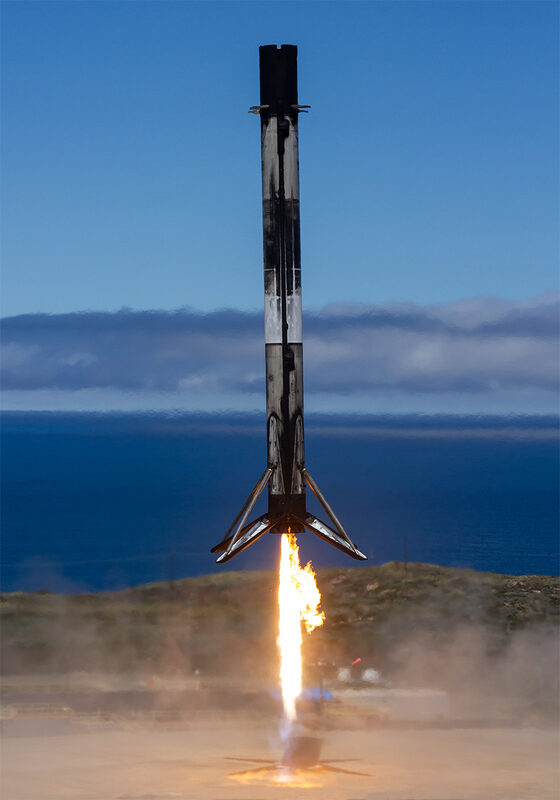
At 5:10 a.m. EDT on July 14, 2026, while most of the Space Coast was still asleep, a Falcon 9 lifted off from Space Launch Complex 40 at Cape Canaveral Space Force Station carrying 29 Starlink satellites into orbit. Nothing about the payload was unusual — SpaceX launches Starlink batches like this several times a week. What made the mission notable was the hardware underneath it: the first-stage booster flying that morning marked the 600th cumulative flight of a reused Falcon booster across SpaceX's entire fleet.
The booster in question, B1080, was making its 28th flight — a résumé that includes two Axiom Space private astronaut missions, the European Space Agency's Euclid observatory, and Northrop Grumman's NG-21 cargo run to the International Space Station. After separating from the upper stage, B1080 flew itself back down to the droneship A Shortfall of Gravitas stationed in the Atlantic, landing successfully. That touchdown was itself a milestone layered on a milestone: SpaceX's 638th total booster landing, and the 161st landing specifically on that droneship, according to Spaceflight Now's launch coverage.
A Number That Sneaks Up on You
Six hundred flights on reused boosters is the kind of figure that doesn't generate much fanfare because it wasn't the point of any single mission — it's an accumulation. What was once an experimental capability, watched with genuine uncertainty by the industry, has become so routine that a booster's 28th flight barely rates a mention in the mission press kit.
That routineness is the story. SpaceX now operates more than 10,800 Starlink satellites in orbit, according to Spaceflight Now's coverage of the Cape Canaveral launch — a constellation that requires a punishing cadence of replenishment and expansion launches to sustain and grow. Starlink missions make up the large majority of SpaceX's 2026 launch manifest, the kind of workhorse, repetitive flying that only makes economic sense if the rocket underneath it is reusable and, increasingly, reused many times over.
Two Coasts, One Week
The Cape Canaveral flight wasn't flying solo that week. A day earlier, on July 13, a separate Falcon 9 lifted off from Space Launch Complex 4 East at Vandenberg Space Force Base in California, carrying Starlink satellites into orbit. The U.S. Space Force's Vandenberg public affairs office confirmed the launch in an official release, and the American Institute of Aeronautics and Astronautics separately reported the mission carried 27 Starlink satellites — a count that, per Space.com's coverage of a related West Coast Starlink flight that same month, falls within the same general range of roughly 24-to-29-satellite batches SpaceX has been flying depending on orbital shell and booster performance margins.
SpaceX's Pacific fleet is led by the droneship Of Course I Still Love You, the mirror-image counterpart to the Atlantic fleet's A Shortfall of Gravitas. Together, the two droneships have become as central to SpaceX's operating rhythm as the rockets themselves — floating infrastructure that turns an expendable-by-default industry into one where the expensive part of the rocket comes home.
Why It Matters
Reusability is no longer a novelty at SpaceX; it is the entire economic engine underneath the company's launch cadence. A milestone like "600th reused-booster flight" is less a single achievement than a odometer reading — proof that the fleet-wide reuse rate has become durable and repeatable rather than a one-off feat performed for headlines. Boosters like B1080, which has now flown missions as varied as crewed Axiom flights, a flagship European science mission, and dozens of Starlink batches, demonstrate that the same hardware can be trusted across radically different risk profiles without being rebuilt from scratch each time.
That reliability compounds. Because SpaceX doesn't need to manufacture a new first stage for every flight, it can sustain a Starlink deployment cadence — and the underlying satellite count of more than 10,800 spacecraft — that would be financially and industrially impossible under a fully expendable model. It also lowers the marginal cost of every other kind of mission that rides alongside or behind that cadence, from national security payloads to commercial satellites to NASA science missions, because the fixed costs of booster production get spread across dozens of flights instead of one.
For the broader launch industry, the number is also a kind of scoreboard. Competitors developing their own reusable or partially reusable systems are implicitly being measured against a fleet that now treats a booster's 28th flight as unremarkable. Whether or not another provider ever matches that specific number, 600 reused-booster flights is a data point that the industry's center of gravity has shifted from "can a rocket be reused?" to "how many times, how routinely, and how cheaply?"
Sources
- SpaceX to launch a flight-proven Falcon booster for 600th time — Spaceflight Now
- SpaceX Falcon 9 rocket launches 24 Starlink satellites from California — Space.com
- Vandenberg Launches Starlink Mission Aboard Falcon 9 Rocket — Vandenberg Space Force Base
- Falcon 9 Carries 27 Starlink Satellites to Orbit From California — AIAA