
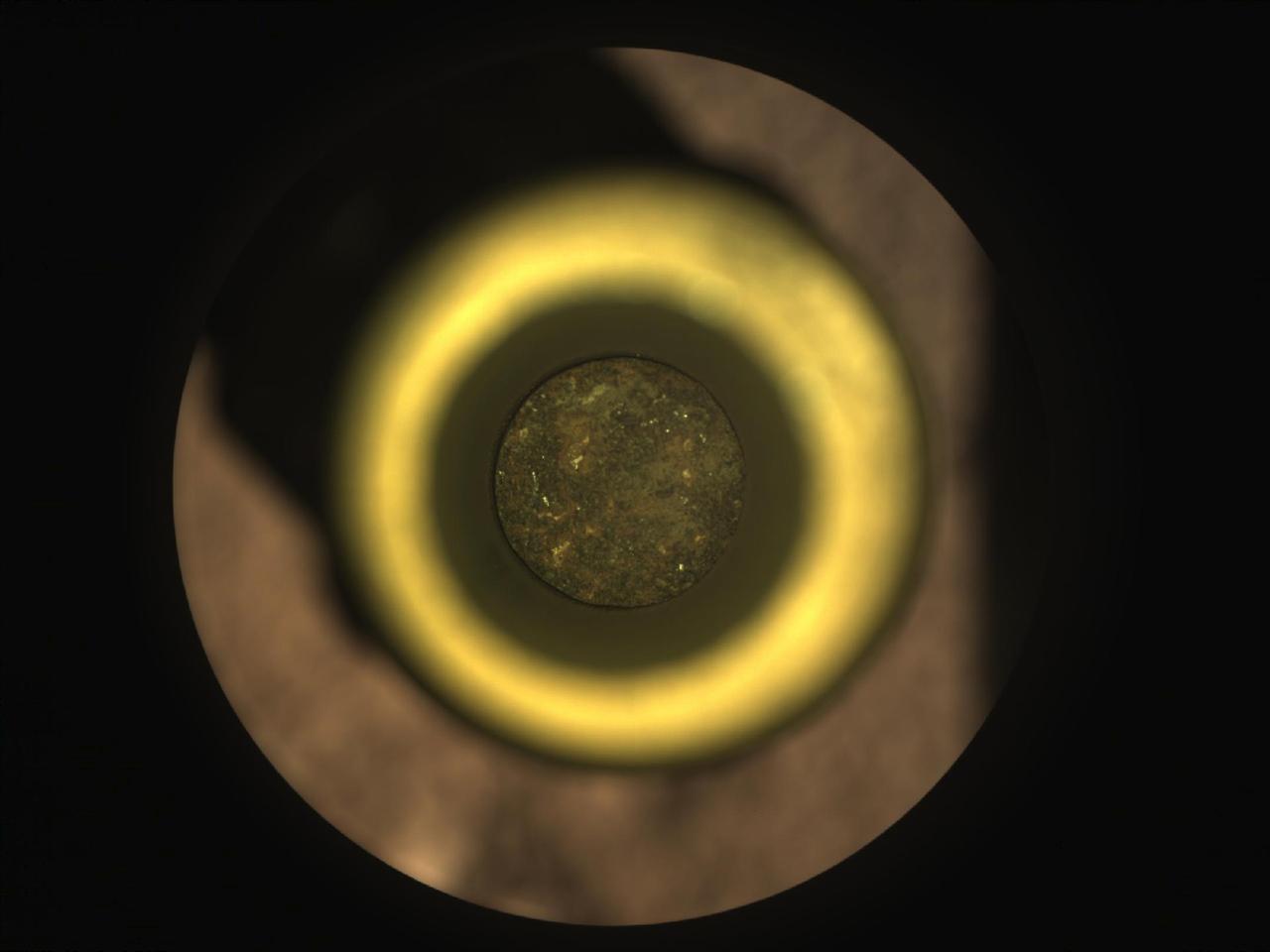
Mars Sample Return is the mission planetary scientists have wanted for decades, and the one that keeps demonstrating how hard the wanting is. The scientific case is unambiguous. Instruments in terrestrial laboratories — mass spectrometers, electron microscopes, the full apparatus of Earth-bound science — can analyse a sample with a sensitivity and flexibility no rover could ever carry, and they can keep doing so for generations as techniques improve. Perseverance is already executing the first step, drilling and sealing carefully chosen cores from Jezero Crater, a former lake delta selected precisely for its astrobiological promise. Returning those tubes to Earth is the problem that has proven so stubborn.
A multi-element relay, every link unforgiving
The baseline NASA–ESA architecture is a chain in which no link has a precedent at Mars. Perseverance delivers its sealed sample tubes to a Sample Retrieval Lander, which must touch down near the rover with high precision. That lander carries a Mars Ascent Vehicle — a small rocket that would become the first object ever launched from the surface of another planet, igniting autonomously after surviving its own entry, descent, and landing. The ascent vehicle lofts the sample container into Mars orbit, where an ESA-built Earth Return Orbiter must locate, rendezvous with, and capture a container roughly the size of a basketball, then break Mars orbit for the long cruise home and a sterile reentry. No prior mission has chained an autonomous launch from Mars to an orbital rendezvous at another planet; either step alone would be a first.
The reckoning
That complexity carried a price the program could not sustain. An independent review concluded the campaign's cost was trending toward roughly eight to eleven billion dollars, with samples not arriving until the 2040s — figures incompatible with the rest of NASA's science budget. Rather than cancel the science outright, the agency effectively paused the baseline and went looking for a cheaper path. As of 2026, NASA describes Mars Sample Return as a future mission still in planning, and is actively assessing competing architectures: it has said it will explore two different landing options for retrieving the samples, and convened a team to weigh proposals that include simplified approaches and contributions from commercial providers. A decision on which architecture to pursue — or whether the campaign proceeds in its current form at all — remains open.
A case study in ambition's vulnerability
The episode illustrates a tension that runs through all of planetary exploration: the missions with the highest scientific value are often the ones whose very ambition makes them most vulnerable to cost growth and shifting political priorities. There is also a quieter layer of difficulty in planetary protection. Returning material from a world that is itself a target in the search for life means the campaign must guarantee containment — the return capsule engineered to keep the samples sealed through a high-speed reentry, the orbiter designed to avoid any chance of back-contaminating Earth. Those requirements ripple back through every element of the design, adding mass, redundancy, and review at each stage. The samples are real and already accumulating in Jezero Crater. Whether the means to retrieve them survives the budget process, and in what form, is now as much a programmatic question as an engineering one — and the answer will shape planetary science for a generation.
What the samples could actually settle
It is worth being concrete about the prize, because it explains why scientists keep fighting for the mission despite the cost. Returned samples could be subjected to high-precision radiometric dating, finally anchoring the absolute chronology of Mars — at present its surface ages are estimated by counting craters and calibrating against the Moon, an approach with large uncertainties. They could be examined for organic molecules and isotopic patterns with instruments far too massive and power-hungry to fly, and re-examined for decades as analytical techniques advance, the way Apollo lunar samples are still yielding discoveries half a century on. Crucially, the search for ancient biosignatures demands exactly this: distinguishing genuine traces of past life from minerals that merely mimic them requires the full, skeptical apparatus of an Earth laboratory, not a verdict rendered remotely by a rover.