
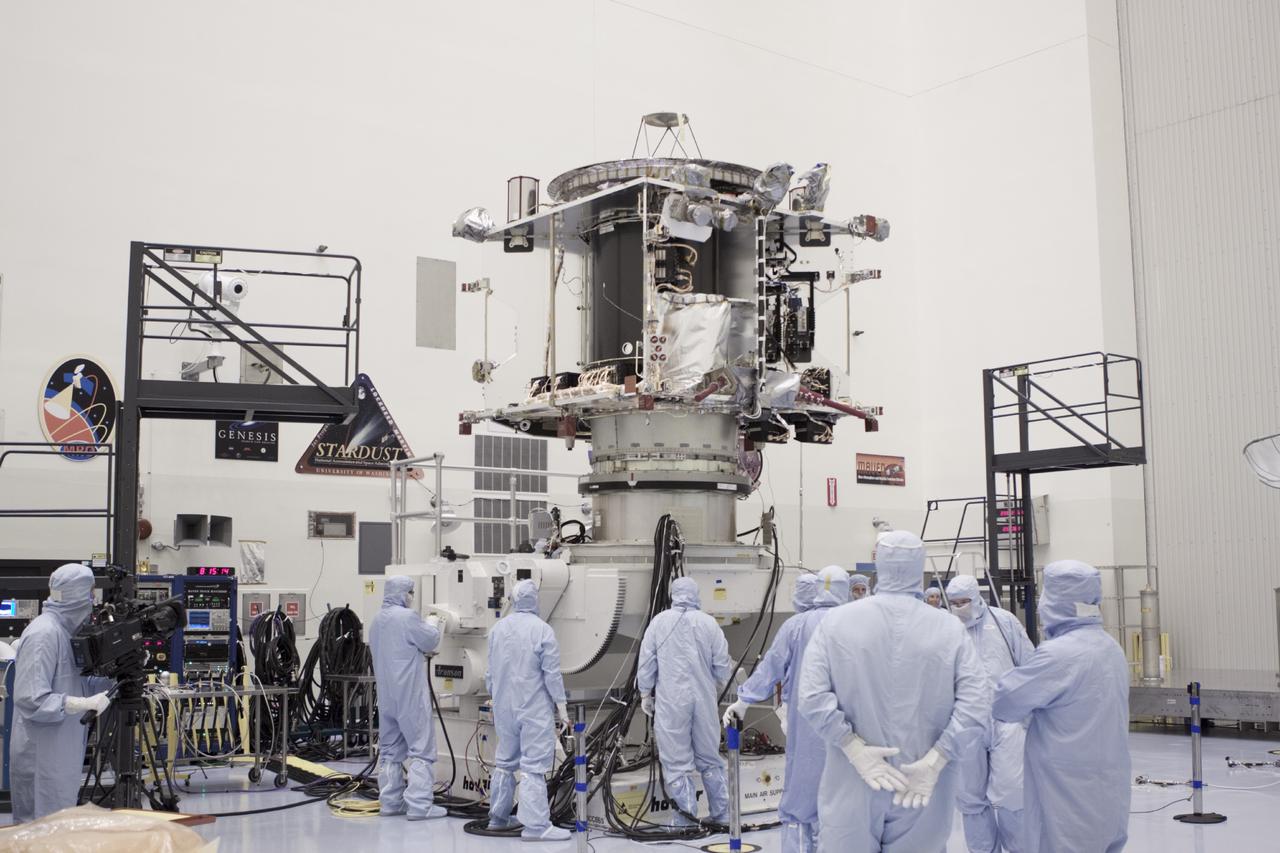
NASA has formally ended the MAVEN mission, the Mars orbiter that spent more than eleven years documenting how the planet lost its atmosphere to space. Launched in November 2013 for a planned one-year survey, the spacecraft instead operated for over a decade before falling silent.
The end came on December 6, when MAVEN — Mars Atmosphere and Volatile Evolution — passed behind Mars and entered a high-speed rotation in safe mode. The spin drained its batteries and starved its communications system of power; an anomaly review board later concluded the spacecraft is not recoverable.
What it changed about Mars
MAVEN's purpose was to explain a planet-scale mystery: how a world that once held liquid water became cold and nearly airless. It showed that solar storms sharply accelerate atmospheric erosion, made the first measurement of atmospheric sputtering at any planet using argon as a tracer, identified previously unknown types of Martian aurora, and tracked how dust storms loft water vapour high enough to escape to space. Over its lifetime it generated more than 800 peer-reviewed publications. It even observed the interstellar comet 3I/ATLAS during the object's pass through the inner solar system.
A workhorse, not just an instrument
MAVEN was also infrastructure. As part of NASA's Mars Relay Network it forwarded data from surface rovers to Earth, and it holds the solar-system record for the most data relayed from another planet in a single day. "The science MAVEN has given us is key to informing what kind of radiation protection and safety measures we must take before sending humans to Mars," said Louise Prockter, director of NASA's Planetary Science Division. That, in the end, is the mission's legacy: not just how Mars died, but what its death tells us about keeping people alive there.