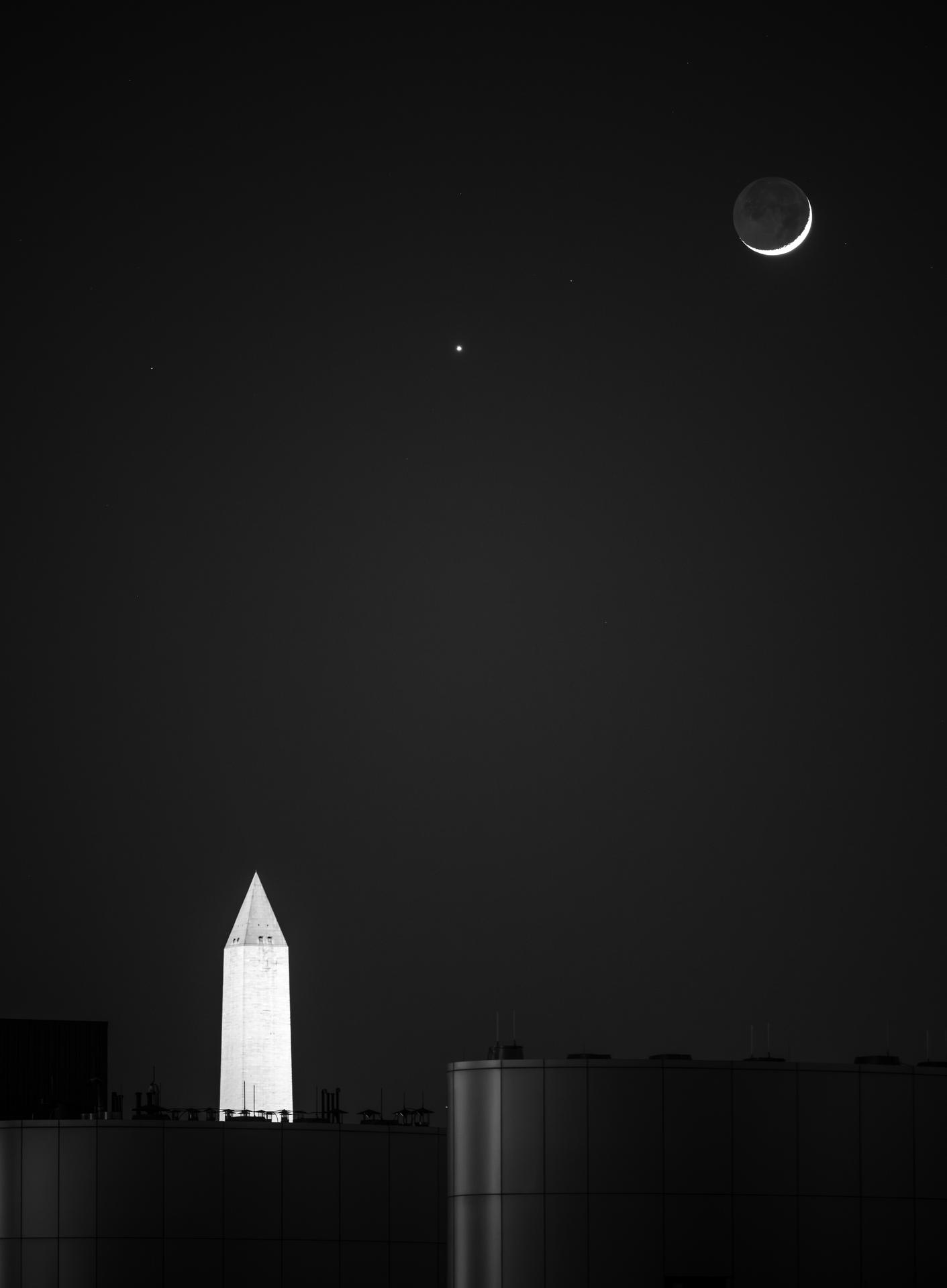
Step outside shortly after sunset this week and look low in the west. A slender crescent Moon is climbing back into the evening sky, and it isn't alone. Venus, blazing as the brightest point of light after the Sun and Moon, is parked just a few degrees away — and both are keeping close company with Regulus, the blue-white heart of the constellation Leo. Over three consecutive evenings, July 15 through 17, 2026, the trio rearranges itself night by night, offering one of the more photogenic naked-eye pairings of the month.
The show opens on July 15. According to EarthSky's night-sky guide, a thin waxing crescent Moon approaches Venus and Regulus after sunset, with all three objects strung out near the ecliptic — the flat plane along which the Sun, Moon, and planets appear to travel. The same evening, the skywatching site When The Curves Line Up notes that Venus itself is in transit near the star Rho Leonis, a fainter member of Leo tucked near the planet's path. Saturn is up before dawn during this same stretch, and Mars continues its slow drift through Taurus, though neither factors into the dusk scene.
The geometry tightens on July 16. Astronomy magazine's weekly sky column pins down the moment precisely: at 9 P.M. EDT, the Moon — by then a slightly fuller, nearly three-day-old crescent — passes just 0.5 degrees south of Regulus, whose magnitude of 1.4 makes it easily visible even against a still-bright twilight sky. That's a strikingly tight pass; half a degree is roughly the apparent width of the full Moon itself. Venus sits about 8 degrees to the upper left of the Moon-Regulus pairing that evening, still separate enough to require a wider glance but close enough to anchor the scene.
By July 17, the choreography flips. The Moon has moved on from Regulus and closes in on Venus instead, passing 2 degrees south of the planet by 1 P.M. EDT — an event that happens in daylight and isn't observable, but sets up the evening view. By the time the sky darkens that night, the Moon and Venus have drawn to within about 6 degrees of each other. Above them both hangs the Coma Star Cluster, also known as Melotte 111, a loose scattering of roughly a dozen stars visible to the naked eye under dark skies and spanning about 4 degrees — roughly the width of three fingers held at arm's length.
One thing that won't happen: no lunar occultation of Regulus occurs on these dates. Astronomy's report puts the Moon's closest pass at 0.5 degrees south of the star, meaning the Moon comes close but never crosses directly in front of it, so there's no dramatic blink-out to watch for this time around.
Skywatchers with sharp eyes — or a pair of binoculars — may also catch earthshine on the Moon's dark limb during these evenings. EarthSky describes this as faint sunlight reflected off Earth itself, illuminating the otherwise-shadowed portion of the crescent Moon with a soft ashen glow. The effect is best seen from mid-northern latitudes and tends to be most striking in the days just after a new moon, which fell on July 14 this year according to NASA's monthly skywatching guide. That guide also lays out the rest of July's lunar calendar: Last Quarter fell on July 7, and the Moon will reach First Quarter on July 21 before becoming full on July 29.
Why It Matters
None of this is rare in the deep-sky sense — the Moon passes near Regulus roughly once a month, and Venus-Regulus conjunctions recur on a predictable cycle as both objects travel near the ecliptic. What makes this particular stretch worth a look is convenience and layering: three distinct, easy-to-find targets (a crescent Moon, the second-brightest planet, and a first-magnitude star) rearrange themselves visibly from one night to the next, all low enough in the west to be caught in the same glance shortly after sunset, and all bright enough to cut through urban skyglow without any equipment. Add earthshine and the Coma Star Cluster for those with binoculars or a dark-sky location, and it becomes a rare case where a five-minute glance out a window and a weekend backyard session with binoculars both pay off — just at different levels of detail. Events like this also serve a quieter purpose: they're a low-stakes, recurring way to learn to navigate the sky by eye, using the Moon as a nightly signpost pointing toward stars and planets worth knowing.