
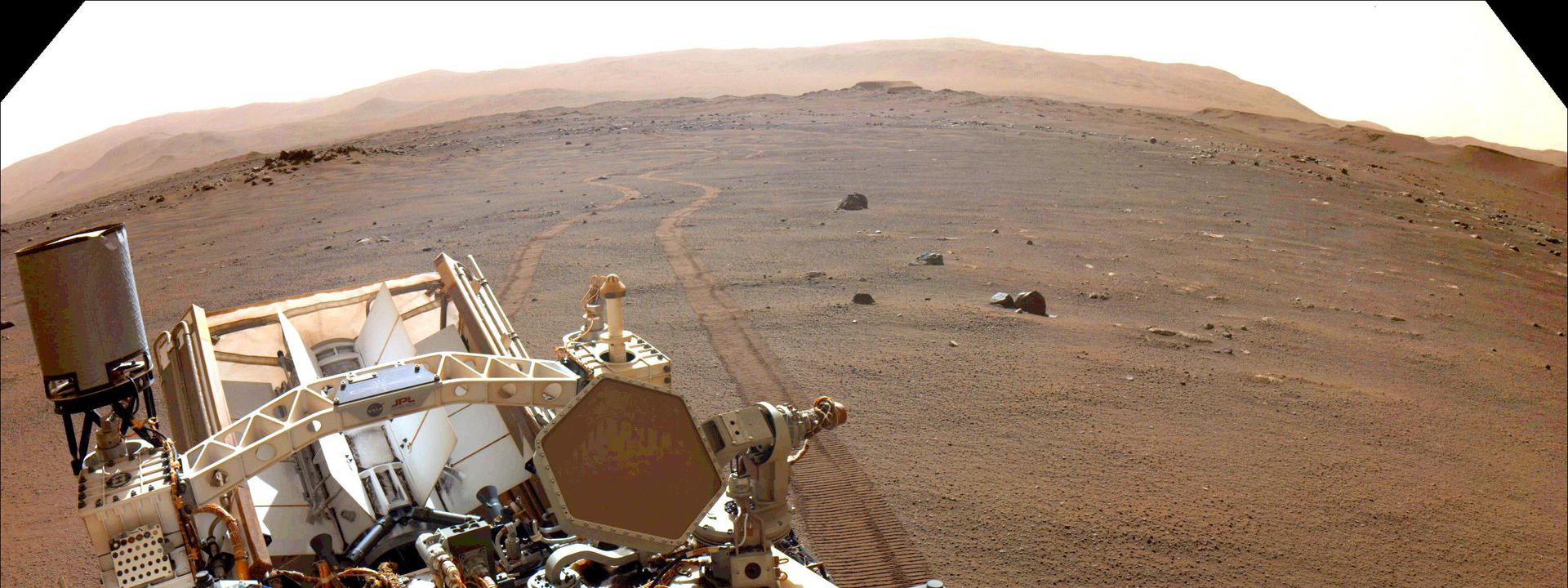
Somewhere in a stretch of Martian terrain nicknamed "Arbot," a six-wheeled robot has quietly done something no human distance runner would envy: it ran a marathon. Not in the sweat-and-cheering-crowds sense, obviously — Perseverance's version took five years and four months, at an average pace that would get you laughed out of any road race. But the number on the odometer is the same one that ends a 26.2-mile course through Boston or New York: 42.195 kilometers.
NASA confirmed the milestone was reached on Sol 1,890 — the rover's 1,890th Martian day on the surface — as Perseverance continued its traverse west of Jezero Crater. The location fits the moment: mission planners have taken to giving waypoints informal nicknames, and this one happened to be called Arbot when the rover's tracks quietly ticked past the marathon distance.
An Orbital Snapshot, One Day Early
The milestone didn't go undocumented. On June 13, 2026 — a day before Perseverance actually crossed the marathon threshold — NASA's Mars Reconnaissance Orbiter swung its High Resolution Imaging Science Experiment camera, known as HiRISE, over the rover's position. HiRISE captured Perseverance itself as a small but distinct green speck, trailing behind it a winding ribbon of tracks pressed into the Martian regolith — a visible record of years of driving rendered in a single frame.
It's a peculiar kind of photograph: a robot on the ground, imaged by a robot in orbit, both built and operated by teams working from a planet tens of millions of miles away. The tracks in the HiRISE image aren't just aesthetically striking — they're a navigational and scientific record, letting mission planners retrace exactly where the rover has been and cross-check its odometry against orbital imagery.
How Perseverance Stacks Up Against Opportunity
The marathon comparison isn't incidental — NASA has leaned on it before, because it offers a clean, human-scale yardstick for what is otherwise an abstract number. Perseverance's predecessor-in-spirit, the Opportunity rover, also eventually covered a marathon's worth of ground on Mars. It took Opportunity 11 years and 2 months to do it.
Perseverance got there in 5 years and 4 months — less than half the time it took Opportunity to cover the same ground. NASA's and ScienceDaily's coverage of the milestone frame that gap as a marker of how far rover technology has advanced across two mission generations, though neither report breaks down the specific engineering differences — power systems, navigation software, or otherwise — that produced the faster pace.
The result is a rover that, on average, covers ground roughly twice as fast as its predecessor did — a gap that becomes obvious the moment you put both mileposts on the same 26.2-mile scale.
Why It Matters
A marathon is an arbitrary unit borrowed from a 2,500-year-old Greek legend, not a scientific benchmark — Mars doesn't care how far Perseverance has driven in miles versus kilometers. But the milestone is a useful proxy for something that does matter: how much ground a rover can realistically cover during its operational lifetime, and how that translates into scientific reach.
Every kilometer Perseverance adds to its odometer is a kilometer of the Jezero Crater region and its surroundings that becomes accessible for sampling, imaging, and analysis — terrain that might hold different rock types, different evidence of past water activity, or different candidate sites for the sample tubes the rover has been caching for eventual return to Earth. A rover that drives faster and farther, without requiring engineers to plan every meter by hand, effectively expands the footprint of the mission's search for ancient habitability without expanding its budget or its clock.
The comparison to Opportunity also matters as a data point for future mission planning. Opportunity's marathon took over a decade partly because of hardware limitations that engineers designing Perseverance's successors — and any future rovers or human-support robots — can learn from. Faster, more autonomous surface mobility isn't just a nice-to-have; it directly determines how much exploration NASA can pack into the finite operational lifespan of a rover before hardware fatigue, terrain hazards, or budget cycles bring the mission to a close.
There's also a simpler, less technical value in milestones like this one: they're legible. Most people don't have an intuitive sense of what 42.195 kilometers of autonomous robotic driving across an alien, rock-strewn desert actually represents. Almost everyone has a sense of what a marathon is. Translating Perseverance's slow, methodical progress into a distance that fits inside a familiar human frame of reference is, in its own way, part of what keeps a five-and-a-half-year mission carried out tens of millions of miles from Earth legible to the public that funds it.