
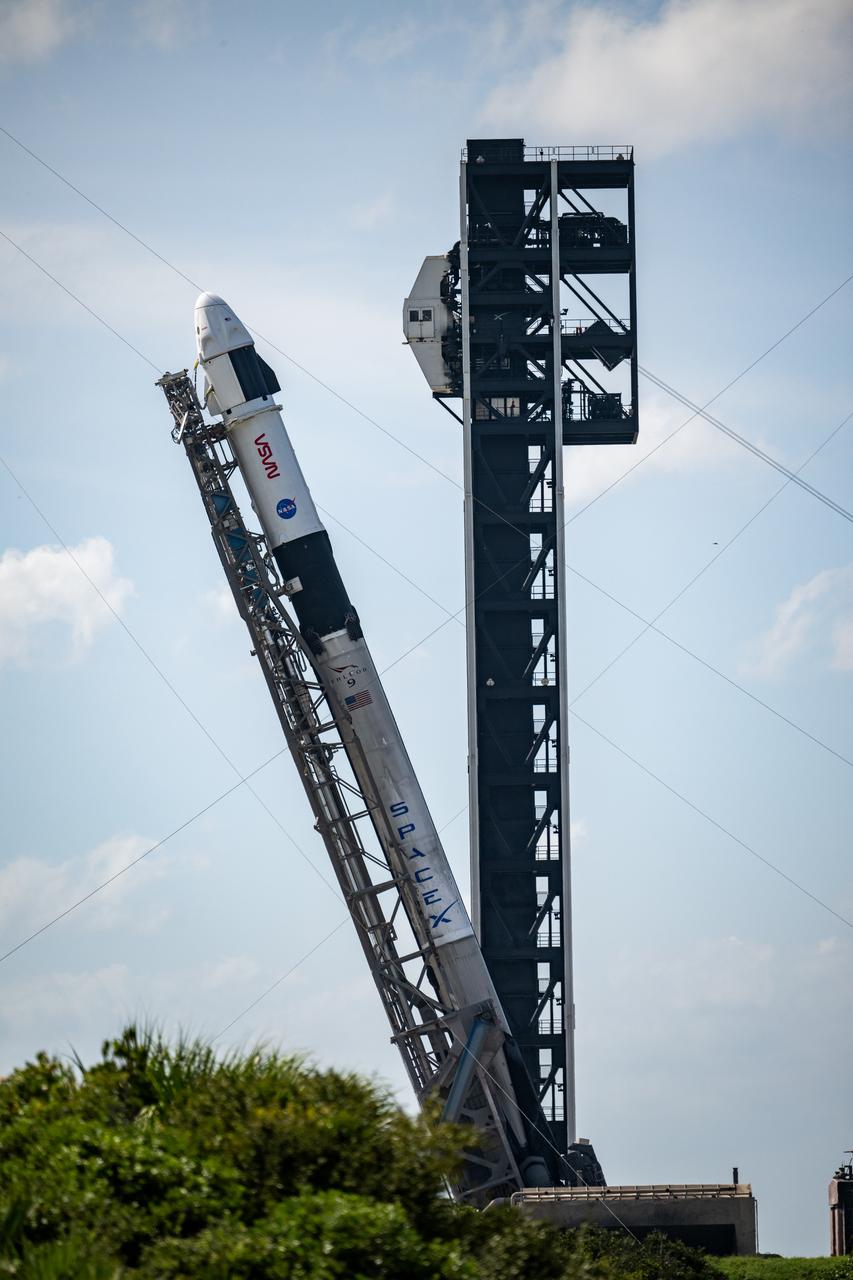
For most of the space age, an orbital rocket was a single-use machine. It cost hundreds of millions of dollars to build, flew once, and ended up at the bottom of the ocean or incinerated on the way down. The conventional wisdom held that recovery would never pay: the hardware needed to bring a booster home, plus the refurbishment afterward, would cost more than simply building a new one. SpaceX's Falcon 9 disproved that operationally, and the consequences have rippled through every part of the industry that depends on reaching orbit.
How a booster comes home
A rocket flies in stages. The large first stage — the booster — does the hard early work of pushing off the pad and through the densest part of the atmosphere, then separates. In a reusable design it does not simply fall away. Using cold-gas thrusters it reorients, relights a subset of its engines for a boostback or entry burn to bleed off speed and limit heating, and steers through the hypersonic descent with grid fins deployed from the interstage. A final single-engine landing burn brings it to a near-hover and sets it down on legs — either at a coastal landing zone or on an autonomous droneship stationed downrange, depending on how much performance the mission can spare. Once recovered, the stage is inspected, refurbished, and flown again, in the best cases many times over with rapid turnaround.
Why cheaper, but not free
The intuition that reuse should make launch nearly free misunderstands where the money goes. Propellant is close to a rounding error; the expensive part is the vehicle itself — the airframe, the engines, the avionics. Reuse amortises that cost across many flights, the way an airline spreads the price of a jet across thousands of trips rather than scrapping it after one. Customers see a discount, not a collapse, because the provider still has to fund the whole enterprise: the recovery fleet, the refurbishment workforce, and the fixed overhead of an operational launch business. There is also a performance cost. The mass and propellant reserved for landing are not available for payload, so a return-to-launch-site recovery imposes a substantial payload penalty, while a droneship landing downrange recovers more of it. For the heaviest payloads, providers still expend the booster — reuse is an optimisation, not a doctrine.
The problem still unsolved
Recovering the booster turns out to be the easy half. The upper stage reaches orbital velocity and must survive a far more punishing reentry, which is why on Falcon 9 it remains expendable. Fully reusable architectures — of which Starship is the most prominent attempt — are a bet that solving upper-stage recovery unlocks the next order-of-magnitude reduction in cost. That capability is not yet demonstrated in routine operation, and it is where the next leap, if it comes, will originate.
What it made possible
The marginal cost of reaching orbit fell far enough to make ventures viable that previously were not. The clearest example is the mega-constellation: networks of thousands of satellites for global internet only close as businesses when launch is cheap and frequent, and reuse is what made that frequency affordable. Lower costs also widened access for universities, startups, and government science missions that could not previously justify a dedicated launch.
Reusability has reshaped the competitive map as well. An expendable rocket now struggles to compete on price against one that flies repeatedly, which is why a wave of new vehicles — Blue Origin's New Glenn, Rocket Lab's Neutron, and Europe's next-generation efforts among them — are being designed around recovery from the outset. There is a cost to that frequency, too, one the industry is only beginning to reckon with: a launch cadence measured in flights every few days raises real questions about orbital congestion, atmospheric effects of repeated reentries, and the regulatory capacity to keep pace. The throughline is straightforward and, by now, permanent: the rocket is no longer disposable, and once that stopped being true, the economics of everything above the atmosphere changed with it. The binding constraint on spaceflight is shifting from the cost of the rockets to the payloads worth flying — and to the orbital traffic those launch rates are steadily filling.