
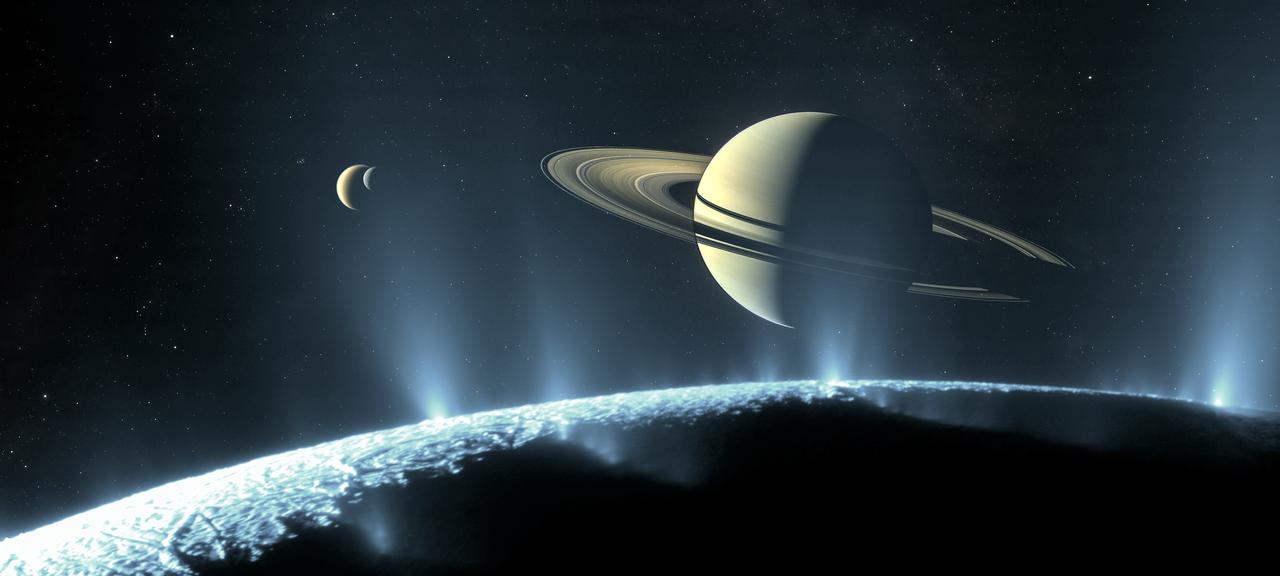
The solar system's moon census keeps getting longer. On March 16, 2026, the Minor Planet Center — the global clearinghouse for small-body discoveries — announced 11 additional moons for Saturn and four more for Jupiter. The new tallies are striking: Saturn's count rose from 274 to 285, and Jupiter's from 97 to 101, cementing Saturn's lead in a quiet rivalry that has seesawed for years as instruments improve.
Tiny, dark, and barely there
These are not moons in the romantic sense. The newly catalogued satellites are roughly two miles — about three kilometres — across, with brightnesses between magnitude +25 and +27, placing them among the faintest objects ever assigned to a planet. They carry provisional designations rather than names: Jupiter's four are S/2011 J 4, S/2011 J 5, S/2018 J 5, and S/2024 J 1, while Saturn's eleven span S/2020 S 45–48 and S/2023 S 51–57. The labels encode the year each was first imaged, a hint that confirming a moon can take years of follow-up.
How you find a three-kilometre rock around Saturn
Detecting objects this faint is a feat of patience and computation rather than a single dramatic observation. Astronomers combine archival images with new ones, searching for points of light that move against the fixed background of stars in the way a distant, gravitationally bound moon should. A candidate must be tracked across multiple oppositions before its orbit is secure enough to earn an official designation — which is why a moon "discovered" in 2026 may carry a 2020 or even 2011 date in its name.
What is accelerating the count is a new class of survey. The Vera C. Rubin Observatory, which became operational in June 2025, issues real-time alerts whenever the sky changes, dramatically speeding the detection of faint, moving objects. As its decade-long survey ramps up, the discovery of small outer moons — captured asteroids and the fragments of ancient collisions, looping far from their host planets on tilted, distant orbits — is expected to continue apace.
Why the number matters
Beyond bragging rights, the swelling population of small irregular moons is a record of the early solar system's violence. These objects are thought to be captured bodies or collisional debris, and the statistics of their sizes and orbits encode the history of how the giant planets snagged passing material and how often their moon systems have been battered. Each new batch refines that picture. The headline number — 285 and counting — is really a measure of how much better we have become at seeing the faint, the small, and the distant, and a sign that the true moon census of Saturn and Jupiter is still far from complete.
Two very different kinds of moon
The distinction that matters scientifically is between regular and irregular moons. Regular moons — the large, famous ones like Titan, Ganymede, and Europa — orbit close to their planet in neat, circular paths aligned with its equator, and almost certainly formed in place from the disk of material that surrounded the young giant. The new discoveries are all irregular moons: small bodies on distant, tilted, often backward (retrograde) orbits. These were not born with their planets but captured later — passing asteroids or comets snared by gravity, or the shattered fragments of larger bodies broken apart in ancient collisions.
A fossil record in orbit
That origin is what makes them worth counting. Irregular moons tend to cluster into families that share similar orbits, the tell-tale signature of a parent body that was disrupted long ago. Mapping how many there are, how big, and how their orbits group together lets astronomers reconstruct the collisional history of the outer solar system — how often the giant planets captured passing material, and how violently their moon systems have been reworked since. As the Vera C. Rubin Observatory's decade-long survey deepens, each fresh batch of faint satellites refines that reconstruction, turning a growing tally into a sharper picture of the solar system's chaotic youth.