
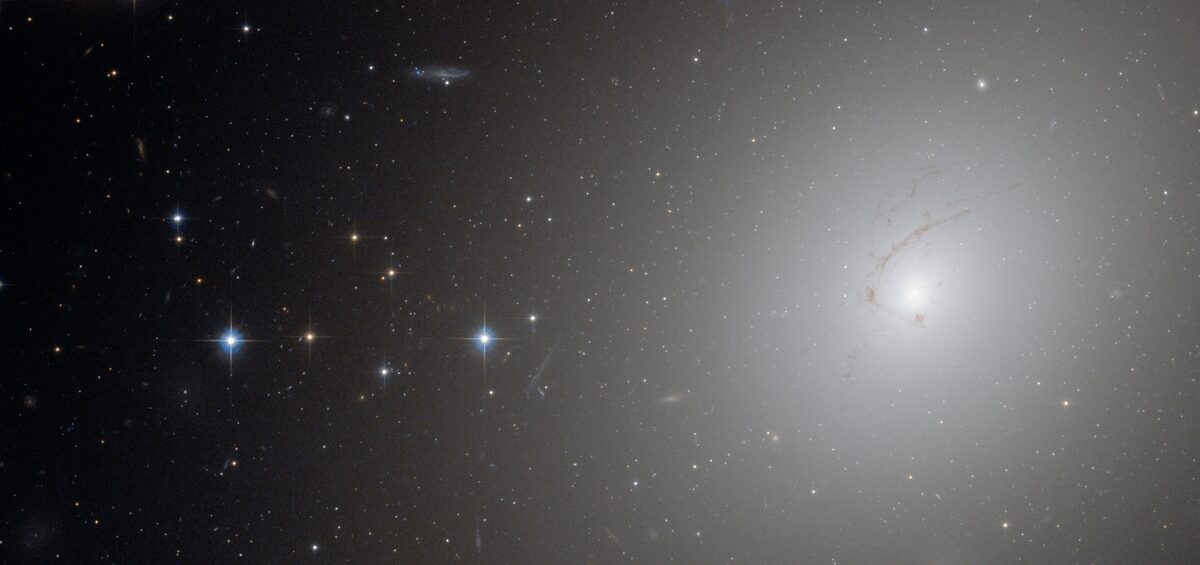
Astronomers have long known that supermassive black holes at the centers of giant galaxies need to eat, and that the fuel ultimately comes from the vast reservoirs of hot gas filling the galaxy clusters around them. What has stubbornly resisted observation is the middle of that story — how gas cascading down from kiloparsec scales actually loses its grip on its own angular momentum and settles into orbit close enough to be swallowed. A new set of JWST observations of NGC 4696, the sprawling elliptical galaxy anchoring the Centaurus Cluster, appears to have caught that intermediate step in the act.
The galaxy sits roughly 145 million light-years away, which is close enough for Webb to pick apart structure that would be a smeared blob in more distant systems. Pointing at the inner 618-by-618-parsec patch of the galaxy's core at a resolution of about 10 parsecs, the telescope resolved a rotating, multiphase circumnuclear disk about 800 light-years across — an S-shaped, spinning structure with gas whipping around at speeds up to roughly 600 kilometers per second. Crucially, Webb also traced a large filament of gas falling inward from farther out and funneling material directly into that disk.
"JWST allowed us to watch gas flowing into the rotating disk around the black hole for the first time," said Gary Ferland of the University of Kentucky, whose widely used Cloudy spectral-modeling code was employed to interpret what Webb saw.
A disk that holds every temperature at once
The word doing a lot of work in this result is "multiphase." The disk is not a single, uniform ring of gas but a coexistence of wildly different conditions — plasma at around 100 million kelvin sitting alongside cold molecular gas, spanning six orders of magnitude in temperature within the same rotating structure. That range is exactly what the feeding model predicts: hot cluster gas cooling and condensing into cold, dense clumps that can actually fall inward, rather than being held aloft by their own thermal pressure.
That is the physical crux of the "missing link" the team describes. On the largest scales, clusters host so-called cooling flows, where the hot X-ray atmosphere radiates energy and should, in principle, rain down onto the central galaxy. On the smallest scales, below about 100 parsecs, the black hole accretes whatever gas manages to reach it. Connecting the two has been the open problem. The Webb data suggest the answer runs through filaments: gas condenses out of the hot halo, threads inward along magnetically guided streams, sheds angular momentum, and delivers itself to the circumnuclear disk, which then feeds the active nucleus.
The self-regulating loop
What makes the picture satisfying rather than merely descriptive is that it closes on itself. Black holes in these galaxies are not passive drains. They launch powerful jets that pump energy back into the surrounding gas, heating it and preventing runaway cooling. But that same heated gas can later cool again, condense into filaments, and fall back in — a feedback loop in which the black hole both starves and feeds itself over cosmic time. The new observations support this self-regulated jet-heating-and-cooling cycle by showing the cooling-and-infall half of it in unprecedented detail.
The team, led by Julie Hlavacek-Larrondo of the Université de Montréal with 37 co-authors, did not rest the interpretation on imagery alone. Magnetohydrodynamic simulations — models that track gas dynamics together with magnetic fields — reproduced the observed filament-to-disk feeding structure, lending weight to the idea that magnetic fields are what channel the infalling gas rather than letting it scatter. And the same mechanism appears to be operating in NGC 1275, the giant galaxy at the heart of the Perseus Cluster, suggesting this is a common way that black holes in cluster-central galaxies get fed rather than a quirk of one object.
Why It Matters
Supermassive black holes and their host galaxies grow up together, and the energy those black holes inject through jets is a leading explanation for why the most massive galaxies stopped forming stars. That whole story depends on a fuel supply, yet the plumbing between cluster-scale gas reservoirs and the black hole itself has been largely inferred rather than seen. By resolving the roughly 800-light-year feeding disk in NGC 4696 and catching a filament in the act of delivering gas to it, Webb turns a plausible model into an observed sequence — hot atmosphere, cooling filament, angular-momentum loss, rotating disk, accretion. Because the same behavior shows up in NGC 1275 and is reproduced by MHD simulations, it strengthens the case that this is how a broad class of black holes eat, not a one-off. That has direct bearing on galaxy-evolution models, which must get the feeding-and-feedback cycle right to explain the shape of the galaxy population we actually observe.
The work was published in the Astrophysical Journal Letters on July 14, 2026, and the team says two follow-up papers are already underway — a sign that Webb's view of the Centaurus Cluster's central engine is only starting to be mined.
Sources
- JWST reveals how black holes are fed: kiloparsec-scale multiphase filaments feed sub-kiloparsec circumnuclear disks (arXiv preprint)
- UK researcher helps solve longstanding black hole mystery — University of Kentucky (UKNow)
- Webb Catches Supermassive Black Hole Feeding from Cosmic Gas Streams — Sci.News