
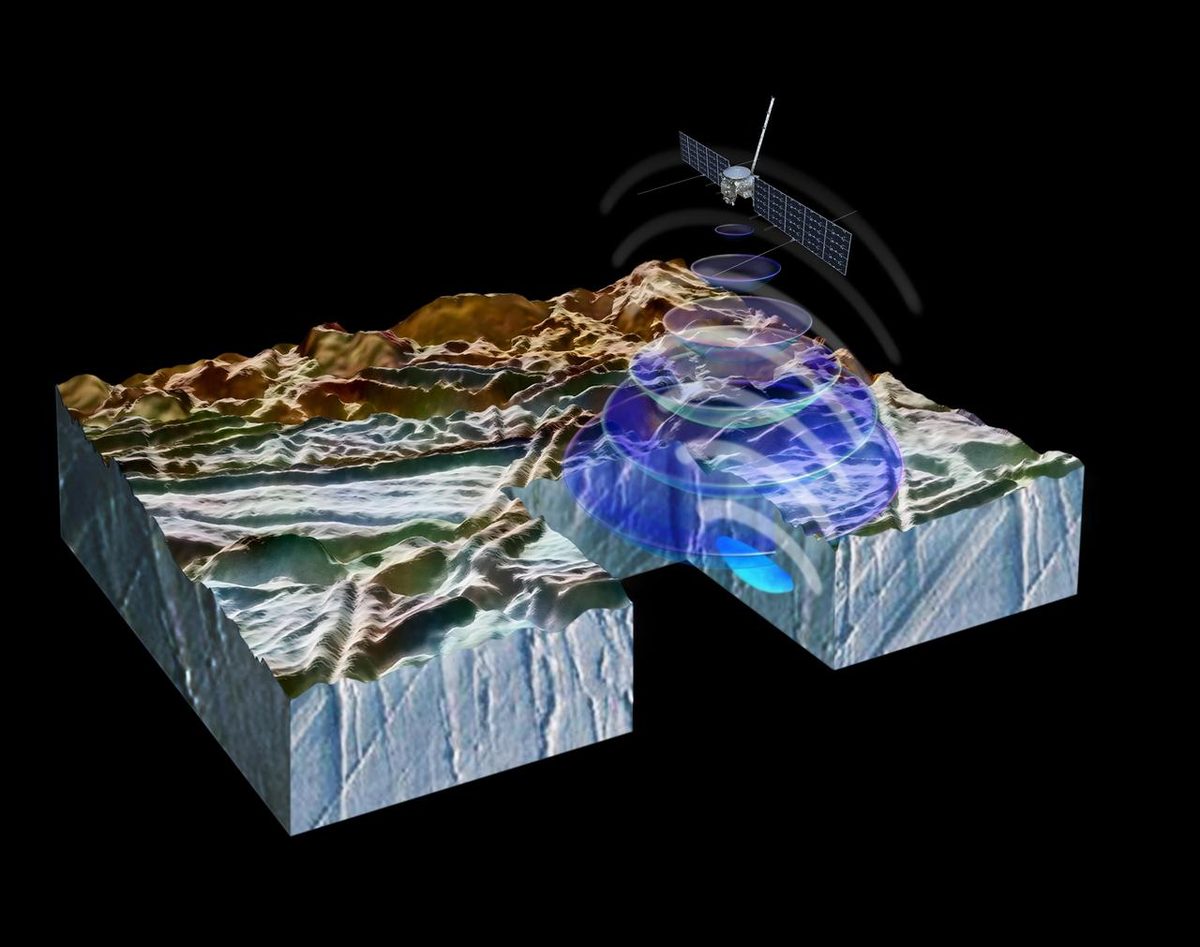
In the years ahead, a spacecraft the size of a basketball court will skim within 25 kilometers of an alien ocean. Europa Clipper — NASA's most capable planetary science mission in a generation — is currently in cruise toward Jupiter, its nine science instruments deployed, checked out, and waiting. The trajectory was designed over decades of theoretical work and refined by years of engineering. When the first close flyby of Jupiter's moon Europa finally arrives, scientists expect it to deliver the most detailed look at one of the solar system's most compelling targets that any instrument has ever achieved.
Europa is not a subtle world. Beneath a shell of water ice that may be anywhere from 10 to 30 kilometers thick, a global saltwater ocean stretches roughly 100 kilometers deep — containing more liquid water than all of Earth's oceans combined. That ocean stays liquid not because of sunlight, which barely reaches this far from the Sun, but because of tidal flexing. Jupiter's immense gravity, combined with gravitational tugs from the other Galilean moons Io and Ganymede, kneads Europa's interior like dough, generating heat through friction. The result is a world in perpetual thermal motion, where the interface between the rocky seafloor and the overlying ocean could, in principle, support chemistry not unlike what happens at Earth's hydrothermal vents.
Nine instruments, one pass
What makes Europa Clipper's approach distinctive is the simultaneity of its observations. Previous missions — primarily the Galileo spacecraft, which made several Europa flybys in the late 1990s — carried fewer instruments and faced the limitation that some could not operate at the same time. Europa Clipper was designed from the start to field a full complement of nine science instruments during each close approach: a magnetometer, a plasma instrument, an infrared spectrometer, an ultraviolet spectrograph, a mass spectrometer, a thermal imager, a surface color imager, a radar sounder, and a gravity science experiment derived from precise tracking of the spacecraft's radio signal.
Each instrument targets a different layer of the Europa system. The radar sounder, called REASON (Radar for Europa Assessment and Sounding: Ocean to Near-surface), will transmit radio waves that penetrate the ice shell and reflect back from subsurface structures — potentially including liquid water pockets, brine lenses, or the ice-ocean boundary itself. The magnetometer will measure distortions in Jupiter's magnetic field caused by Europa's electrically conductive interior, allowing scientists to infer the presence, depth, and salinity of the ocean without seeing it directly. The mass spectrometer will hunt for molecules escaping from the surface or from any active plumes, sampling the thin exosphere for signs of compounds that might indicate what the ocean chemistry looks like.
The spacecraft launched on a SpaceX Falcon Heavy rocket in October 2024 and spent its early cruise phase checking out and calibrating each instrument. Engineers used observations of the Earth-Moon system shortly after departure to verify instrument performance — a well-characterized nearby target is ideal for establishing baseline readings before any instrument is expected to do real science. The spacecraft is now well into cruise, following a trajectory that uses gravity assists to build the velocity needed to reach Jupiter, with arrival targeted for April 2030. The first dedicated Europa flyby will come after Jupiter Orbit Insertion, kicking off a sequence of 49 planned close passes designed to build global coverage of the moon over the course of the prime mission.
Reading the magnetic field
The magnetometer results scientists anticipate from the first Europa flyby represent a planned major advancement over Galileo's measurements. Galileo's magnetometer established in 1998 that Europa almost certainly harbors a global conducting layer — almost certainly a saltwater ocean — by detecting how Jupiter's rotating magnetic field induced currents in that layer, which in turn modified the field Europa's instruments measured. But Galileo's coverage was limited and its instrument far less sensitive than Clipper's.
Europa Clipper's magnetometer, MAGIC (MAGnetometer for Investigation of Clipper's Interplanetary environment), will sample the magnetic environment continuously through each closest approach, building a profile of how the induced field varies along the flyby track. The pattern of that variation carries information about the geometry of the conducting layer — particularly its depth and how well it conducts electricity. A saltier ocean conducts better; a deeper ocean sitting beneath a thicker ice shell produces a subtly different induced signature than a shallower one just beneath thin ice. Matching the observed signal to physical models will let scientists constrain those parameters with far greater precision than Galileo ever could.
The plasma instrument, PIMS (Plasma Instrument for Magnetic Sounding), works in concert with MAGIC, measuring the charged particle environment around Europa to help disentangle induced magnetic signals from noise introduced by Jupiter's intense radiation belts. Europa orbits within one of the harshest radiation environments in the solar system, and separating genuine ocean-derived signals from the electromagnetic chaos of that environment has always been the central challenge of magnetic sounding at Europa. Having both instruments operating simultaneously is precisely how Clipper was designed to meet that challenge.
The surface in high resolution
Europa's surface is visually striking in ways that remain poorly understood. The Galileo cameras revealed a world covered in a network of reddish-brown lineae — long fractures and ridges — interrupted by chaotic terrain where the ice appears to have been disrupted and refrozen. The reddish coloring is thought to be caused by radiation-processed salts, possibly magnesium sulfate or sodium chloride, leached upward from the ocean below. But Galileo's imaging covered only a fraction of Europa's surface in any detail, and much of the moon has only been seen at low resolution.
During each Clipper flyby, the EIS (Europa Imaging System) wide-angle and narrow-angle cameras will acquire images in multiple wavelengths at resolutions approaching a few meters per pixel in the closest approach corridor. These images are expected to reveal surface features at a scale never before seen: individual ridges resolved into double-ridge structures with medial troughs, chaos terrain showing the detailed margins of refrozen blocks, and lenticulae — dome-like surface disruptions possibly formed where warm ice diapirs rose from depth — at a fidelity that allows meaningful comparison to geophysical models.
The ultraviolet spectrograph, UVS, will simultaneously scan for auroral emissions and absorptions that reveal what species are present in Europa's thin exosphere and on the surface itself. Water ice, sulfur dioxide, and carbon dioxide have all been detected at Europa by previous instruments; one of Clipper's key goals is to determine whether the surface also shows signs of organic compounds, which would have profound implications for the ocean's habitability. Carbon dioxide was definitively detected by the James Webb Space Telescope in 2023, concentrated in chaos terrain in a pattern suggesting the ocean is its ultimate source. Clipper's spectrographs will build on that discovery with the spatial resolution to map those concentrations across each flyby corridor.
The mission design calls for 49 close passes over the course of the prime mission, spiraling through different geometries to build up global coverage and to repeatedly sample any active plume sites. Scientists have suspected since Hubble observations in 2012 that Europa occasionally vents water vapor from its southern hemisphere, though confirming persistent plume activity has been frustratingly difficult. The mass spectrometer — MASPEX, the most sensitive instrument of its kind ever flown to the outer solar system — is waiting for the pass that brings Clipper directly through one of those potential eruption columns.
What this mission must establish is how well the spacecraft performs in the enormously complex environment of Jupiter's magnetosphere — with radiation levels capable of degrading electronics over time and a science payload that must be coordinated across nine instruments in near-real time. The engineering team has spent years hardening the spacecraft against that environment and modeling its behavior. The ocean Europa Clipper is traveling to study has been there for billions of years. It is not going anywhere. But when the spacecraft arrives at Jupiter in 2030, it will finally be close enough to ask questions that no instrument has ever been in position to ask.