
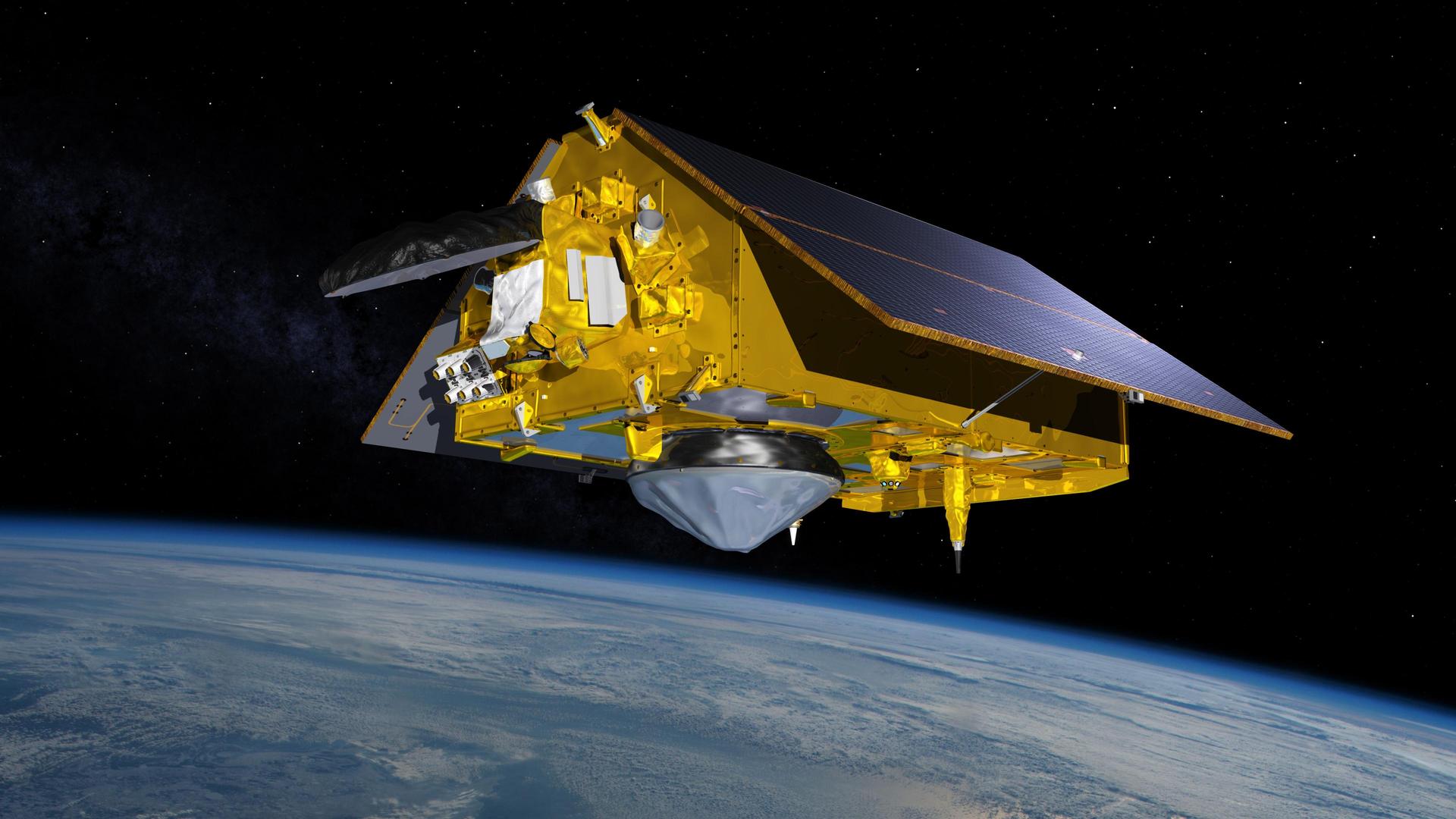
On June 15, 2026, the U.S. Space Force quietly placed an order that says a great deal about the state of modern electronic warfare. It bought two more GPS satellites. Not flashy new constellations, not a reusable rocket milestone, but two production spacecraft, designated SV23 and SV24, from Lockheed Martin for $514 million. The buy nudged the next-generation GPS IIIF order to 14 spacecraft and pushed the program's cumulative value to roughly $4.6 billion under a 2018 contract that can stretch to as many as 22 satellites.
It is the kind of procurement that rarely makes headlines, and yet it is one of the clearer windows into how the military's positioning, navigation, and timing (PNT) backbone is being rebuilt to survive a contested sky. The signal that comes out of a GPS satellite is faint by the time it reaches a receiver on the ground, which makes it trivially easy to drown out with a cheap jammer or fool with a spoofed waveform. The GPS IIIF satellites are, in large part, an answer to that problem.
What you actually get for $514 million
Each GPS IIIF space vehicle bundles several capabilities that, taken together, distinguish it from the GPS III satellites that came before. The headline feature is M-Code, the encrypted, anti-jam, anti-spoof military signal designed to be far harder to overpower or imitate than the legacy military code. M-Code is the part of the spectrum the Pentagon cares about when it talks about resilience.
The IIIF spacecraft also carry a fully digital navigation payload. That phrasing is easy to skim past, but it matters: a digital payload can be reconfigured in orbit through software, rather than being frozen into hardware at launch. In a domain where the threat evolves faster than a satellite's decade-plus design life, the ability to reprogram signal behavior after the spacecraft is already on station is a meaningful hedge.
Then there is the Regional Military Protection feature, which is the most tactically interesting item on the list. Rather than spreading encrypted signal power evenly across the planet, Regional Military Protection lets the constellation concentrate the power of its encrypted military signal over a specific geographic area. In practice, that means a commander can push a stronger, harder-to-jam military signal over a particular battle area, raising the bar for any adversary trying to deny GPS in that theater.
None of this is purely a military story. The same satellites broadcast modernized civilian signals, including L1C and L5, which improve accuracy and reliability for the enormous civilian ecosystem that depends on GPS, from aviation to agriculture to the phone in your pocket. The GPS IIIF program is explicitly framed as upgrading PNT for both military and civilian users, improving accuracy, reliability, security, and resilience against jamming and electronic threats.
Why the timing matters
This order does not arrive in a vacuum. In April 2026, the 10th and final GPS III satellite reached orbit, closing out that production block. GPS IIIF is the successor line, and it is being purchased in batches: the prior order came in at $509.7 million, and the SV23/SV24 buy at $514 million continues that incremental cadence. Building these spacecraft two at a time, rather than committing to all 22 up front, lets the Space Force spread cost and fold in lessons as the threat picture shifts.
There is also a hard operational reason to keep buying. Every spacecraft on orbit is a wasting asset, and a constellation that is not continuously replenished slowly degrades, both in coverage and in the resilience of its signals. The IIIF buys are, in effect, the replacement pipeline that keeps the constellation healthy while simultaneously hardening it.
A constellation, not a satellite
It is worth stepping back from the dollar figure to appreciate what GPS actually is: a globe-spanning utility that most people never think about until it fails. GPS does not just tell you where you are. The timing signals it broadcasts synchronize banking transactions, telecommunications networks, and emergency-response services. When people talk about GPS resilience, they are talking about protecting infrastructure most of us assume will simply always be there.
That is why the modernization is structured the way it is. M-Code hardens the military signal. The digital payload buys flexibility against threats that have not been invented yet. Regional Military Protection lets the constellation push back locally where it counts. And the steady drumbeat of two-satellite orders keeps the whole thing replenished. Lockheed Martin, which builds the spacecraft in the Denver, Colorado area, now has 14 GPS IIIF vehicles under contract, with room for more.
Why It Matters
GPS jamming and spoofing have moved from theoretical concern to routine feature of modern conflict, and the faint signals that reach the ground are inherently vulnerable. The GPS IIIF line is the U.S. military's structural response: a navigation backbone that can be reprogrammed in orbit, that broadcasts a tougher encrypted military signal, and that can focus that signal where a fight is happening. A $514 million order for two satellites looks small against the spectacle of new rockets, but it is the unglamorous, incremental work of keeping a piece of critical global infrastructure both alive and hard to break. For everyone who relies on GPS, civilian and military alike, this is what resilience looks like when it is actually being built rather than merely promised.